← Hub
Manhattan Mental Health Counseling — Episode 05
Why Smart People Get Overwhelmed Emotionally
Gate 1B · Storyboard Review · May 19, 2026
28
Shots
15
Beats
~2:48
Est. Runtime
Beats
Hook1
Scene3
Failure Landing1
Mechanism1
Memory3
Workaround2
Worked Beat1
Transition1
The List3
Silent / Tradeoff2
The Corner2
The Analogy5
Uncomfortable Hold1
Final Line1
End Card1
Design Rationale & Dev Notes
Why this storyboard looks the way it looks
A short read before the boards. Every alteration from Gate 1A was a deliberate call — the reasoning behind each one is walked through below. The frames you're about to see are storyboard-quality reference renders for composition and direction approval. A cleanup / regrade pass runs in After Effects before video production starts.
01 · Headline Treatment Decision

Memory + Analogy = unified VHS treatment in post

Gate 1A specified "dreamlike-hazy" for the memory shots (007, 008, 009) and "full diffusion" for the analogy section (021–025). Through the storyboard build I tested both directions live and made a single unification call: all memory and analogy beats get a 1991-era VHS treatment applied in After Effects post, on top of clean cinematic base gens.

Why VHS over dreamlike-hazy. The dreamlike-hazy direction lands as either "soft-focus drift" (too gentle, reads as nostalgia) or "lens diffusion artifact" (too contemporary, reads as a filter). VHS does double duty: it reads as the memory itself is a recording the protagonist is replaying (conceptual — exactly the show's thesis), AND it's the literal format of Adam's actual childhood. He's in his early-to-mid 40s now; the memory beats land roughly 1989–1993, peak VHS era. The treatment means "this is a memory" and "this is from that time" at the same time. It also gives the memory beats and the analogy beats a single visual code so the analogy lands as memory-intrusion, not as a separate dream sequence.
Why clean bases. Iterative dreamlike gens are hard to undo if a beat needs adjustment. Clean cinematic bases give us full flexibility to grade, comp, and apply the VHS treatment uniformly across all six shots — so the treatment reads consistent in edit instead of varying gen-to-gen. Status: the VHS treatment is represented across all six memory-mode shots in the storyboard frames — memory beats (S007/S008/S009) and analogy beats (S021/S022/S023). Still being refined before video production; the frames give the register.

The hammer-on-glass thesis (the wrong-tool argument) is unchanged. The treatment is the visual code carrying it.
02 · Per-shot alterations since Gate 1A

What changed, and why

03 · Steven Gate 1A direction — confirmed addressed

All ten items from Gate 1A v2 are in the boards

1. Adam, more rugged. Thicker eyebrows, fuller hair, slight stubble. Workshop guy.
2. Mother confirmed. Same identity in Memory 1 and Analogy Beat 3. Business casual, mid-call, hand up without looking.
3. The drawing. Three stick figures, tallest in middle, blue/yellow crayon, bent corner top-right. Continuity locked.
4. Thesis at top. "A man who solves things, using the wrong tool on the only thing he can't solve."
5. Workshop framing. Two registers — real (apartment) and ritualized (workshop). Carried through.
6. Treatment ladder. S011/S020 visually identical, S021–S025 distinct via VHS treatment (replaces "full diffusion" — see Section 01 above).
7. Wrong-tool staging. Full hammer, small nails — disproportion preserved, not softened.
8. Phone state arc. Workshop appearances 1 & 2 explicitly "not in frame — left face-down in the kitchen." Analogy Beat 4 is the first time the phone enters the workshop.
9. Breath gradient. Upper-chest through S018; first diaphragm release at S026.
10. Failure Landing / Silent Sequence. Phone explicitly absent in S005 (not face-down — gone). All four body cues locked in S017: shoulders / held breath / fingers curled / long blink.
04 · Outstanding before video production

What's still in motion

001
0:00 – 0:05
Hook
Kitchen Sink — Morning
EnvINT. Apartment Kitchen
TimeMorning · Soft natural light
Dur~5s
PhoneFace-down on counter
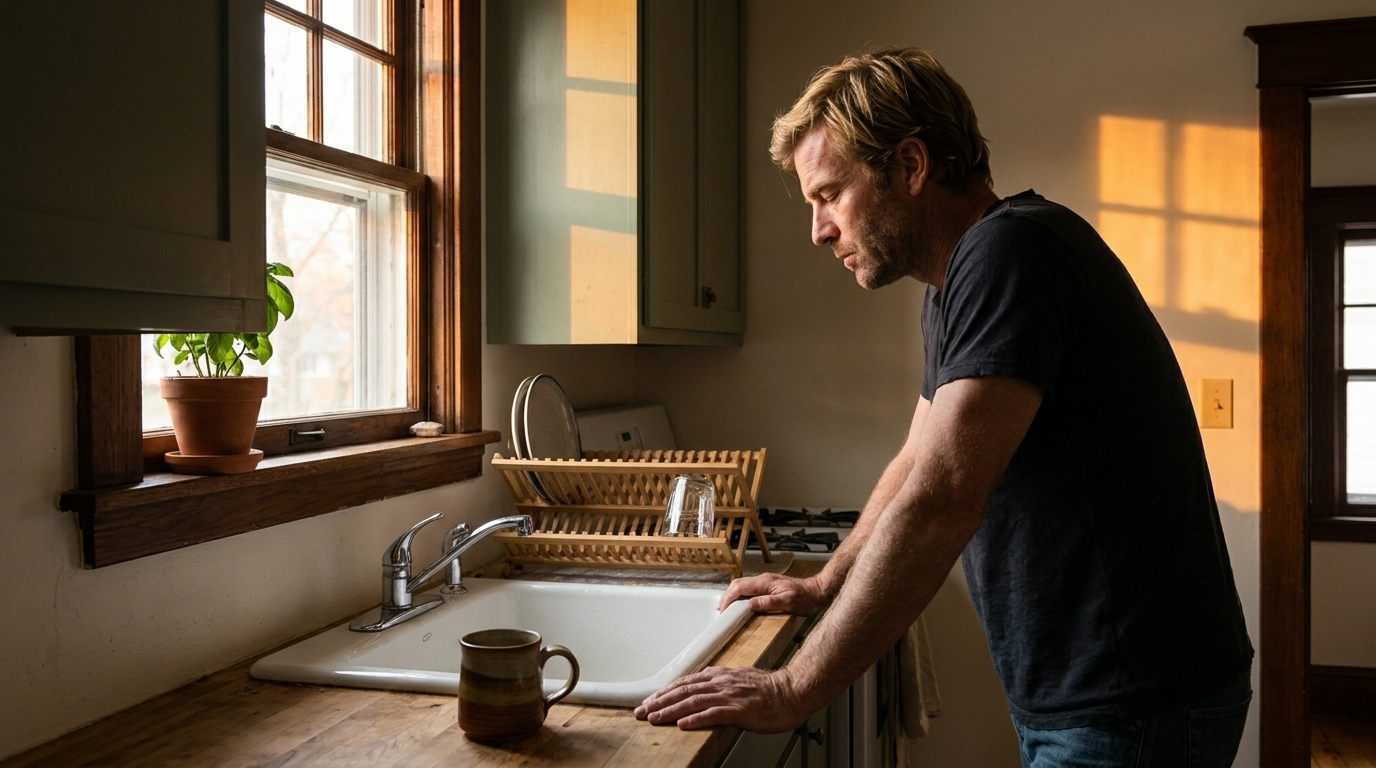
Adam at the sink, three-quarter angle, face fully readable in frame. Rinsing a single glass under running water, slowly. The act is methodical — cleaning what's already clean. Body: slow blink, small visible exhale. Upper-chest breath only — controlled, does not fully drop.
Adam: blond, professional bearing, early-to-mid 40s, rugged — thicker eyebrows, fuller hair, slight stubble. Camera holds face in frame throughout. Breath gradient begins here — upper-chest only for every beat until Shot 026.

"A feeling doesn't ask to be understood. It asks to be felt."
002
0:05 – 0:09
Scene
Hallway — Replaying
EnvINT. Apartment Hallway
TimeContinuous through day
Dur~4s
PhoneNot in frame
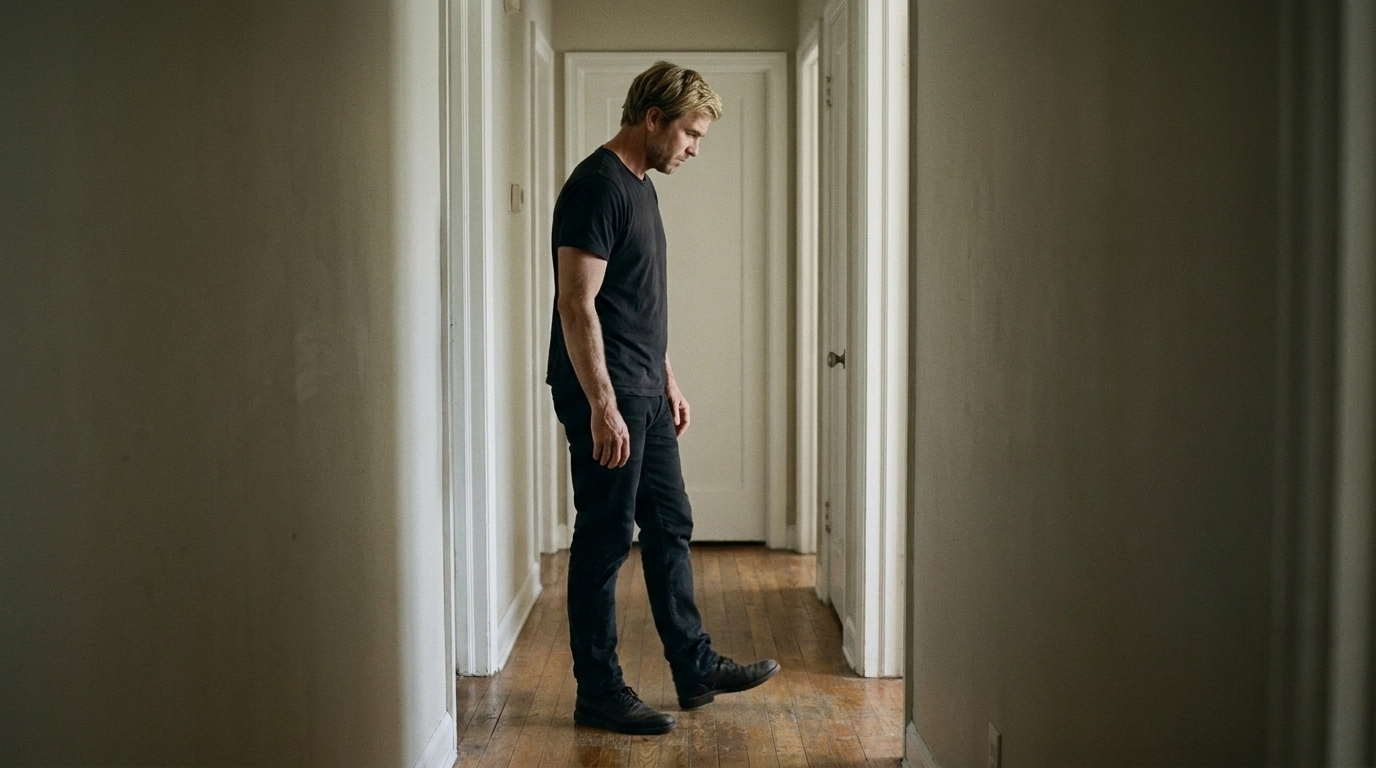
Adam walking down the hallway. Stops mid-step. Stares at the floor. Continues walking. The stop reads as internal processing, not a reaction to anything external — not startled.

"You're still working out what happened yesterday. You replayed it."
003
0:09 – 0:14
Scene
Couch — Drafting
EnvINT. Apartment Living Room
Dur~5s
PhoneIn hand — message drafted, then deleted
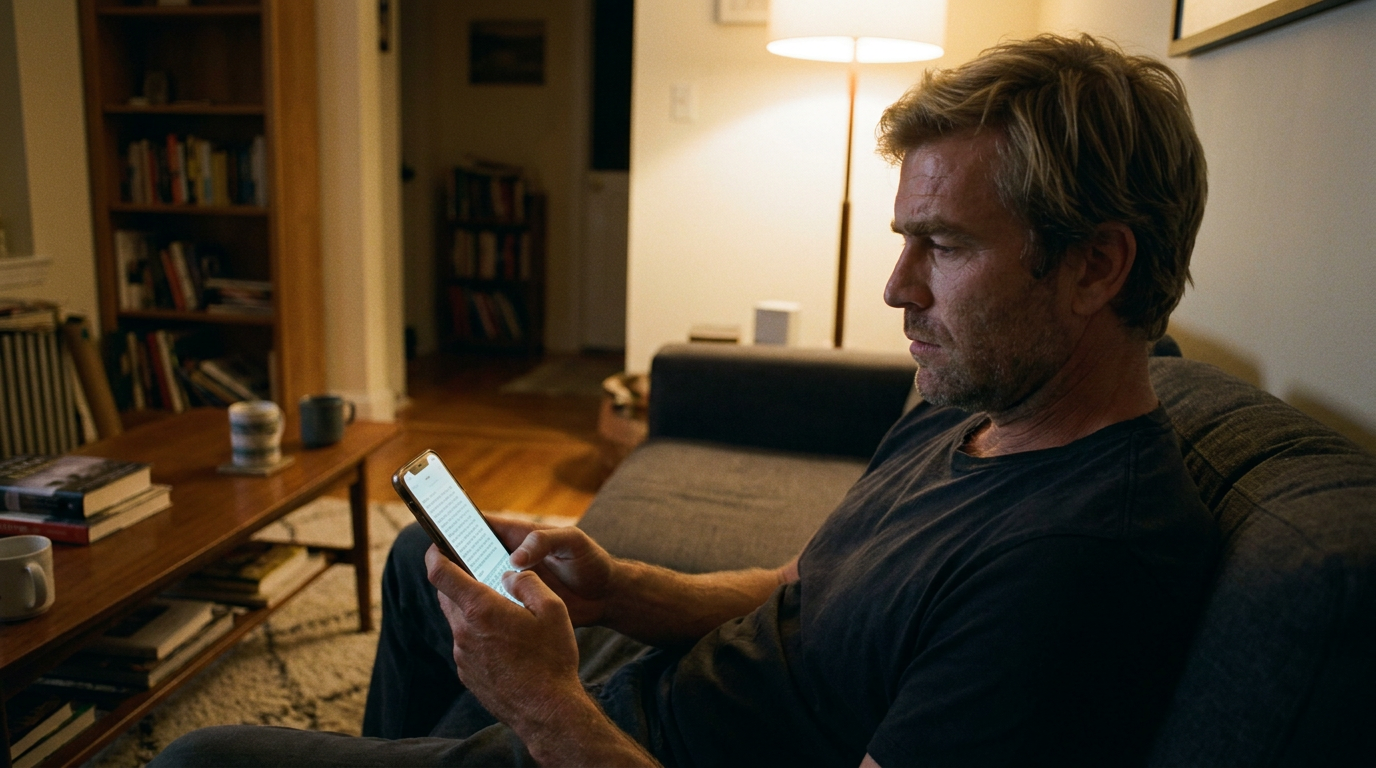
Adam on the couch, phone in hand. Drafting a long message — long thumbprint of text visible on screen. He pauses. Deletes the whole thing. Text disappears. We read the weight from screen density and his face — text legibility not required.

"You looked at it from their side."

004
0:14 – 0:18
Scene
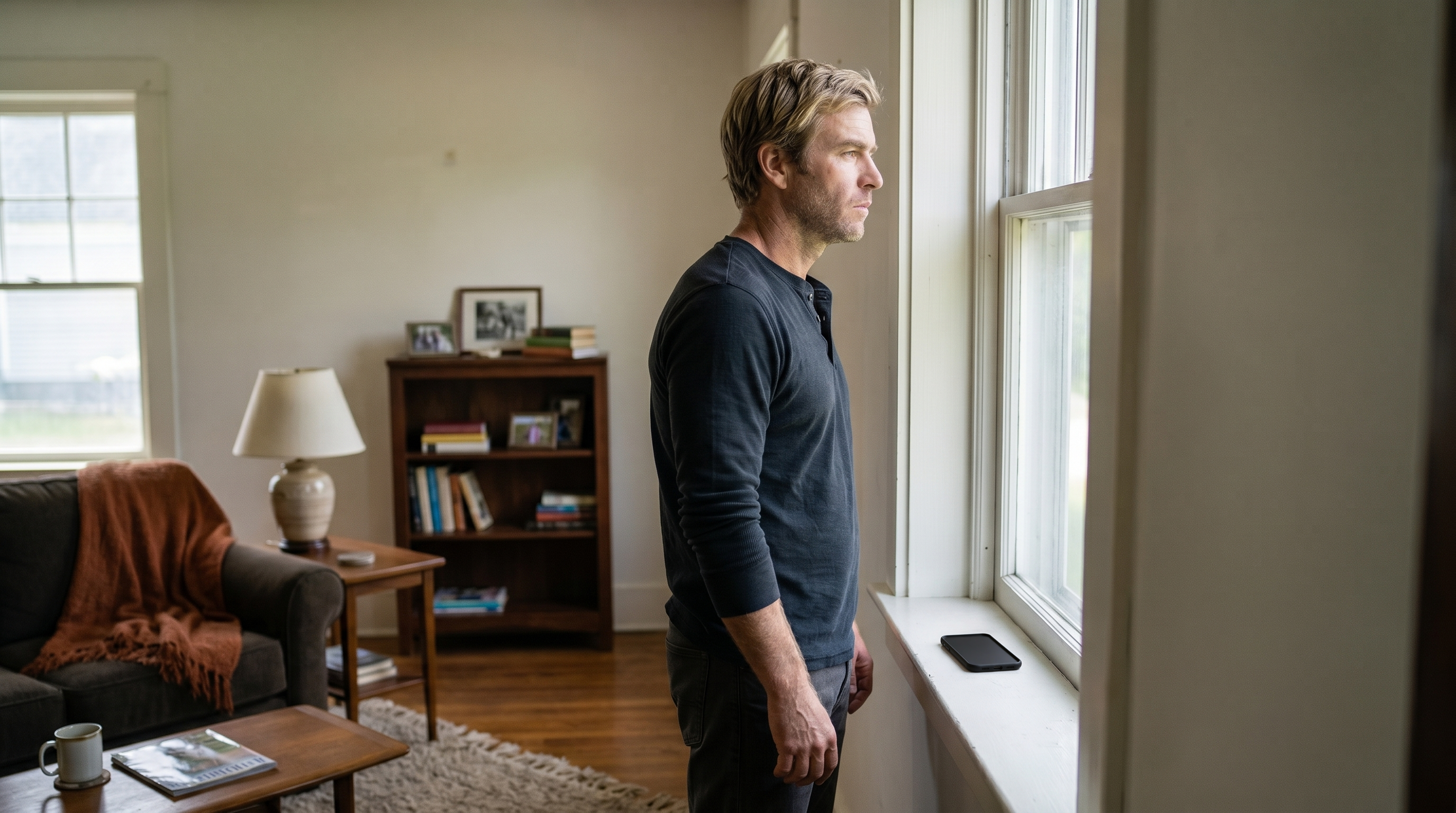
Window — Lips Moving
EnvINT. Apartment · Living Room
Dur~5s
PhoneFace-down on sill
Adam at the full-height living-room window, phone face-down on the sill beside him. Standing upright, three-quarter angle to the glass, looking out, lips parted very slightly — articulating something silently. He's working it out alone. Tight medium framing. Lived-in living room behind him: short dark-stained bookcase tucked in the back-left corner (books, framed photos, plant), overstuffed sofa partial reveal with rust throw blanket on the visible end, side table with ceramic lamp, coffee table edge, area rug. Craftsman window casing matching the kitchen.
Re-rendered 2026-05-19. Original Gate 1A frame had the right composition + character but the room read empty (vacant rental). Re-built with the locked Living Room dressing: furniture pushed against the camera-left wall, NOT floating in the middle; short bookcase in the back corner (not floor-to-ceiling); craftsman window casing made to match the kitchen so the house reads consistent. Tighter framing on Adam vs. the iterative passes.

"You mapped why they reacted that way. You explained it to yourself."
005
0:18 – 0:25
Failure Landing
Kitchen Sink — Evening
EnvINT. Apartment Kitchen
TimeEvening · Warmer, lower light
Dur~7s
PhoneNOT in frame — gone from counter
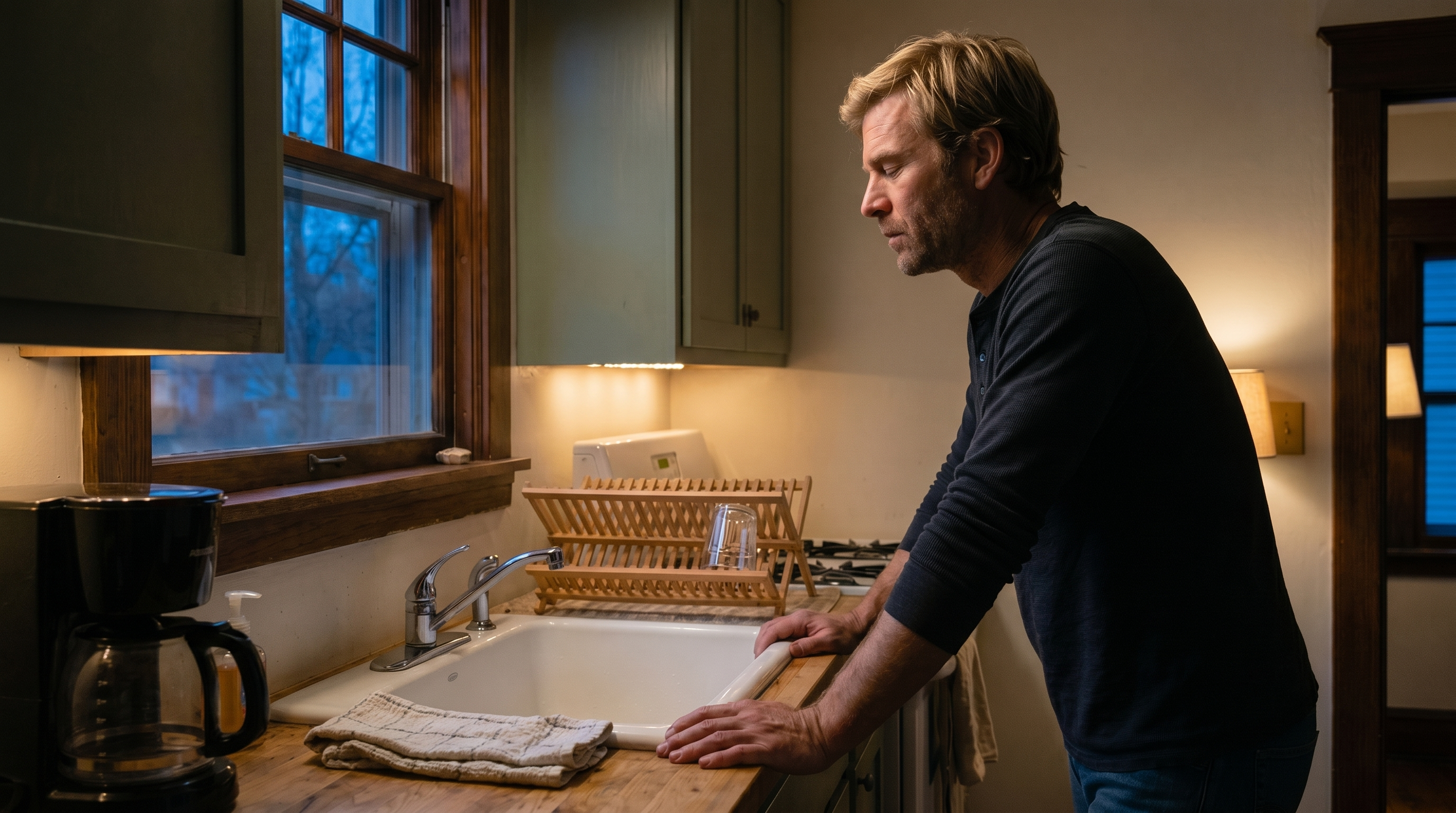
Same composition as Shot 001 — same kitchen, same angle, same man. Three changed elements: evening light (not morning), glass is now dry on the drying rack, phone is NOT on the counter. Adam standing where he was, holding nothing. The sink is empty. Body: hands resting on the counter, long blink, shallow visible breath in chest.
⚠ Continuity: phone must be completely absent from this frame — not face-down on counter, not anywhere visible. Glass on drying rack, dry. Evening light register is the time marker. Visual rhyme with Shot 001 is the structural argument.
Locked 2026-05-19. Dusk register — deep blue twilight outside the window, warm under-cabinet LED pool on the counter. Window/sink camera-LEFT matches S001 orientation exactly. Same kitchen, same camera, no plant on sill, drying rack with single glass camera-right, phone absent. The light shift morning→evening is the only time marker. AE cleanup pass before video production.

"The feeling is exactly where you left it."
006
0:25 – 0:30
Mechanism Opens
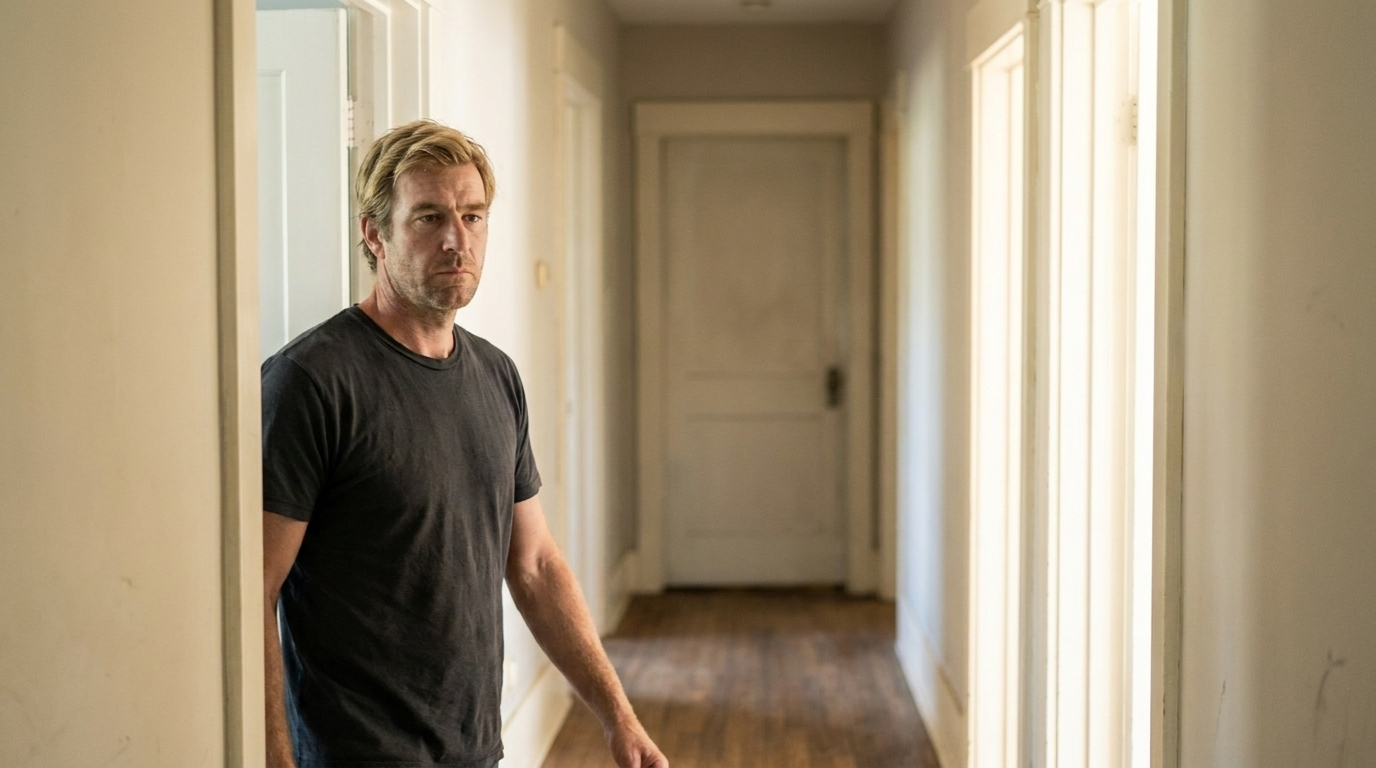
Doorway — Mid-Step
EnvINT. Apartment Doorway
Dur~5s
PhoneNot in frame
Adam crossing a doorway between rooms. Mid-transition, one step across the threshold. The VO line catches him mid-crossing.

"Thinking didn't start as a habit. It started as a job."
007
0:30 – 0:33
Memory Montage
Memory 1 — The Drawing
EnvMEMORY · Childhood Living Room
AgeChild ~5–6 (youngest)
Dur~3s
Treat.VHS treatment applied (memory mode)
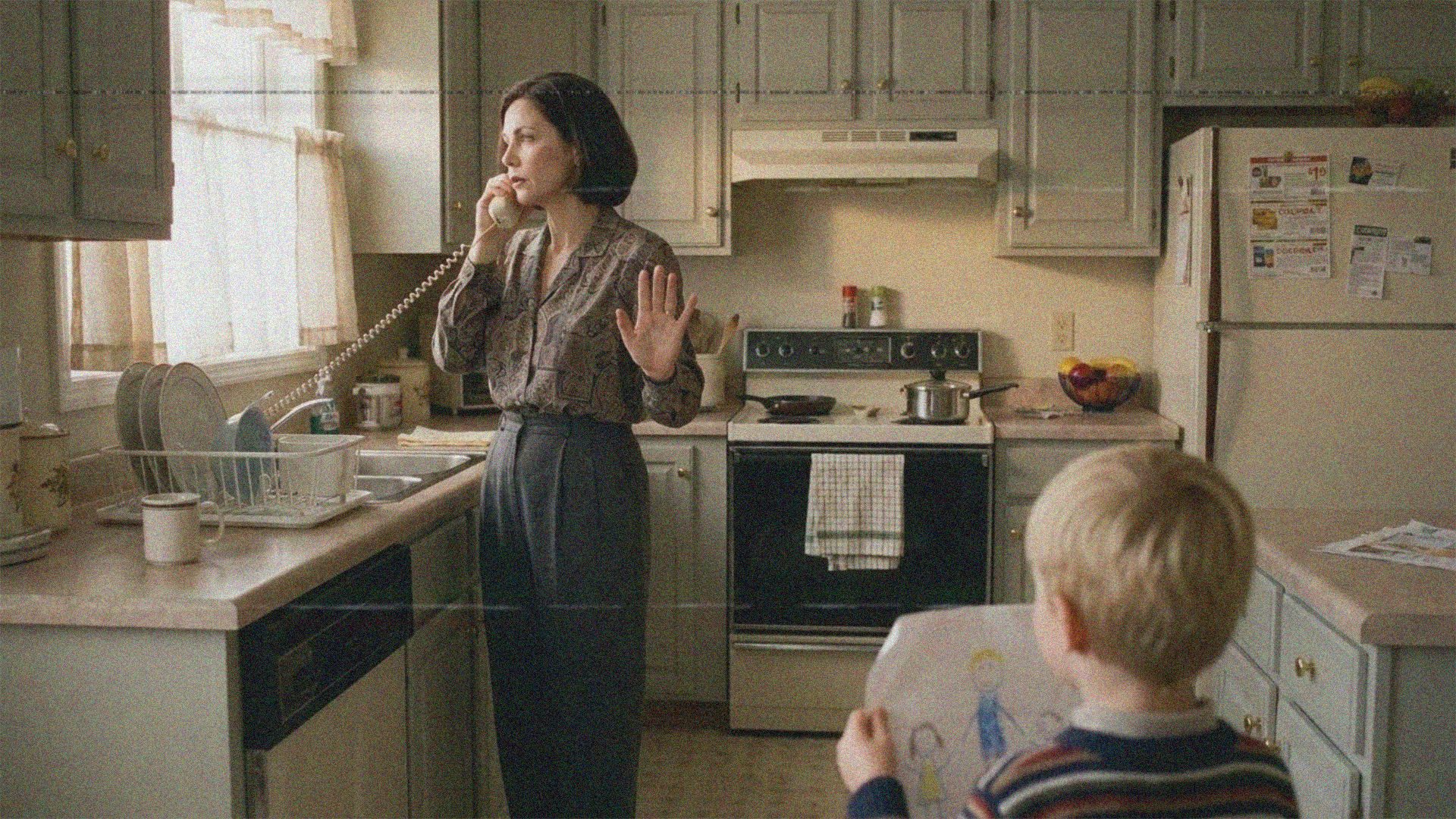
Child (~5–6, young Adam) holding a drawing toward his mother, who is mid-sentence on a phone call. Her other hand comes up fast — palm out, fingers together, chest height. Holds ~1 second, drops casually back. She never breaks eye contact with the call. Child lowers the drawing, smooths the bent corner (top right), walks away. THE DRAWING: three stick figures, tallest in center (parent), smaller on either side. Crayon, mostly blue and yellow. Bent corner top right.
Treatment note · 1991-era VHS treatment is represented in this frame and across all memory + analogy shots. The look is still being refined before video production; the frame gives the register. See Section 01 of the Design Rationale above.
⚠ Critical continuity: the drawing and the "not now" hand both reappear in the Analogy (Beat 2 = same drawing offered to adult Adam; Beat 3 = same hand silhouette). Render both memorably. Bent corner top right is the callback identifier. Mother: business casual, mid-sentence — her hand is a fast interruption-cut-off, not a held barrier.

"Somewhere early, expressing what you actually felt was costly. Disapproval."
008
0:33 – 0:36
Memory Montage
Memory 2 — Building
EnvMEMORY · Childhood Bedroom
AgeChild ~7–8
Dur~3s
Treat.VHS treatment applied (memory mode)
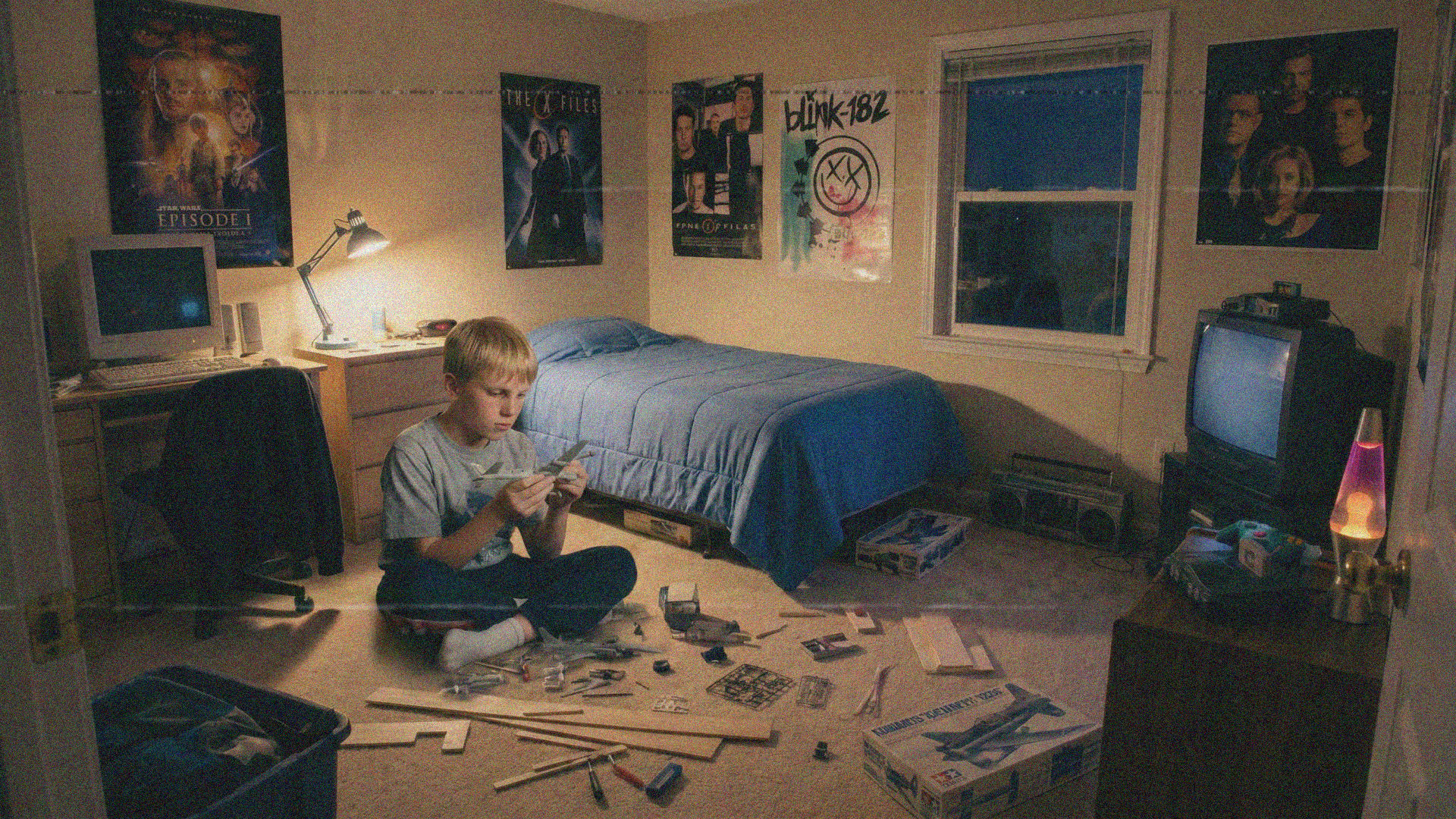
Child (~7–8, young Adam) alone in his bedroom at night, building a model carefully on the floor. The room outside is loud — voices rising and falling (non-dialogue, unintelligible). The child keeps building. Total focus on the model.
Same child visual reference across all three memory shots — differentiate by age and wardrobe only. Sounds of voices audible but not intelligible — audio rule holds.
Re-rendered 2026-05-19. Original Gate 1A frame had soft dreamlike diffusion baked in. Re-built as a clean cinematic base, then the 1991-VHS memory-mode treatment was layered on — same code as S007/S009 and the analogy beats. Treatment still being refined before video production.

"Distance."

009
0:36 – 0:39
Memory Montage
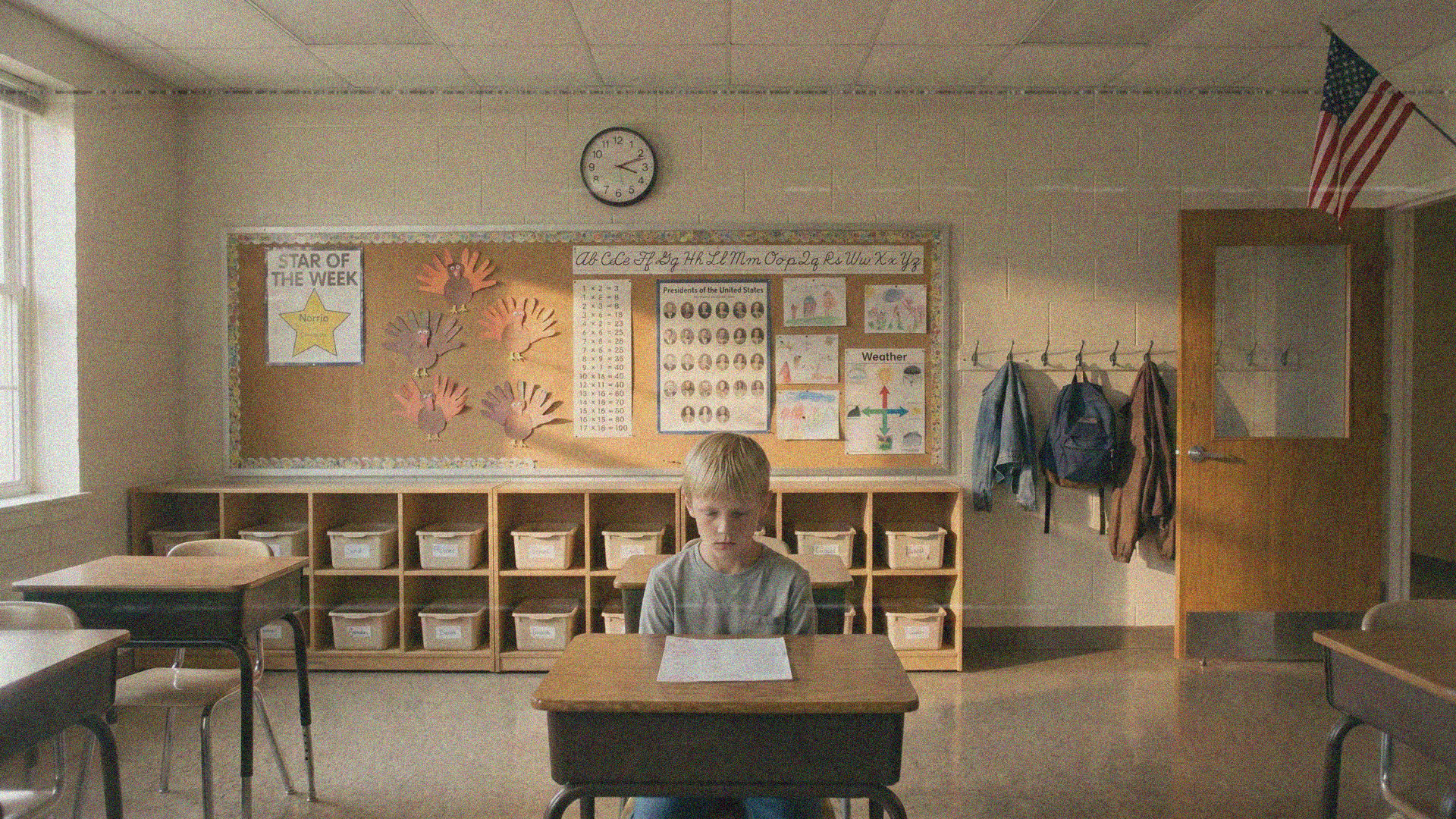
Memory 3 — Classroom
EnvMEMORY · Classroom
AgeChild ~9 (oldest)
Dur~3s
Treat.VHS treatment applied (memory mode)
Child (~9, young Adam) alone at a school desk. Other desks empty around him. Graded paper with red marks visible in front of him. He looks at the marks. No expression. He composes himself — locks it down. The classroom reads as authentic late-80s American elementary: cork bulletin board with Star of the Week, hand-print turkeys, multiplication-facts strip, Presidents chart, weather chart, cursive handwriting strip; row of wooden cubbies with beige plastic supply bins below; coat hooks with backpacks; analog wall clock; American flag in corner.
New location ref created 2026-05-19. Original Gate 1A classroom ref showed the front of the room (chalkboard wall, teacher's desk). For S009's geometry — kid faces the chalkboard, camera sees him from the front — the visible environment behind him is the back of the room. Generated a back-of-classroom companion ref (`hf_20260519_112738_b71fd8ab`) and added it to the E05 location library. Bulletin board content pushed to period-correct late-80s artifacts.

"A room going quiet."

010
0:39 – 0:44
Workaround
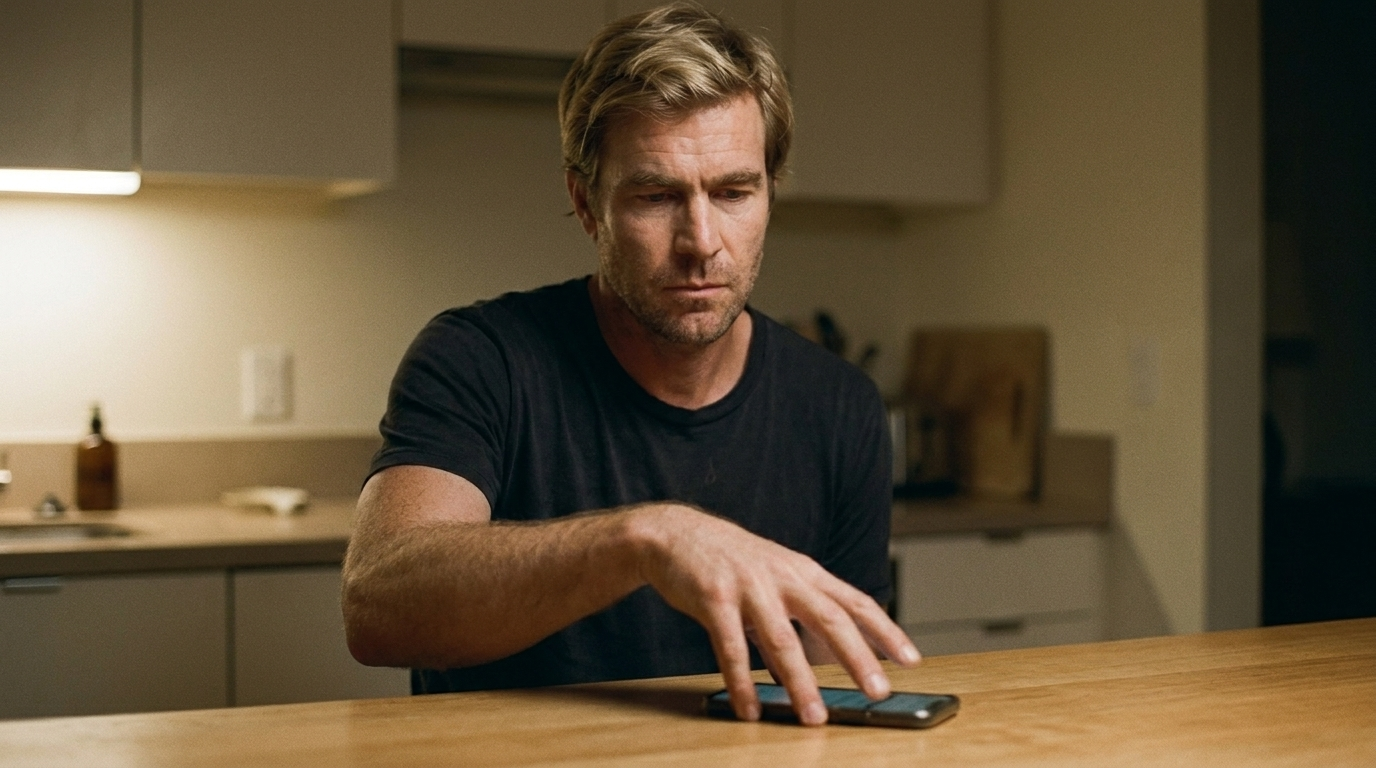
Kitchen — Phone Trigger
EnvINT. Kitchen
Dur~5s
PhoneFace-up lit → face-down
Adam in the kitchen. Phone face-up on the counter. It buzzes. Adam reads the screen — partner's name visible, tense message (text not legible; we read weight from layout and his face). Body: flicker in the eyes reading the screen, jaw tightens for a half-beat, then composure returns. He puts the phone face-down without urgency. Walks out of frame.

"So the system found a workaround. Stay clear. Stay competent. Handle it."
011
0:44 – 0:50
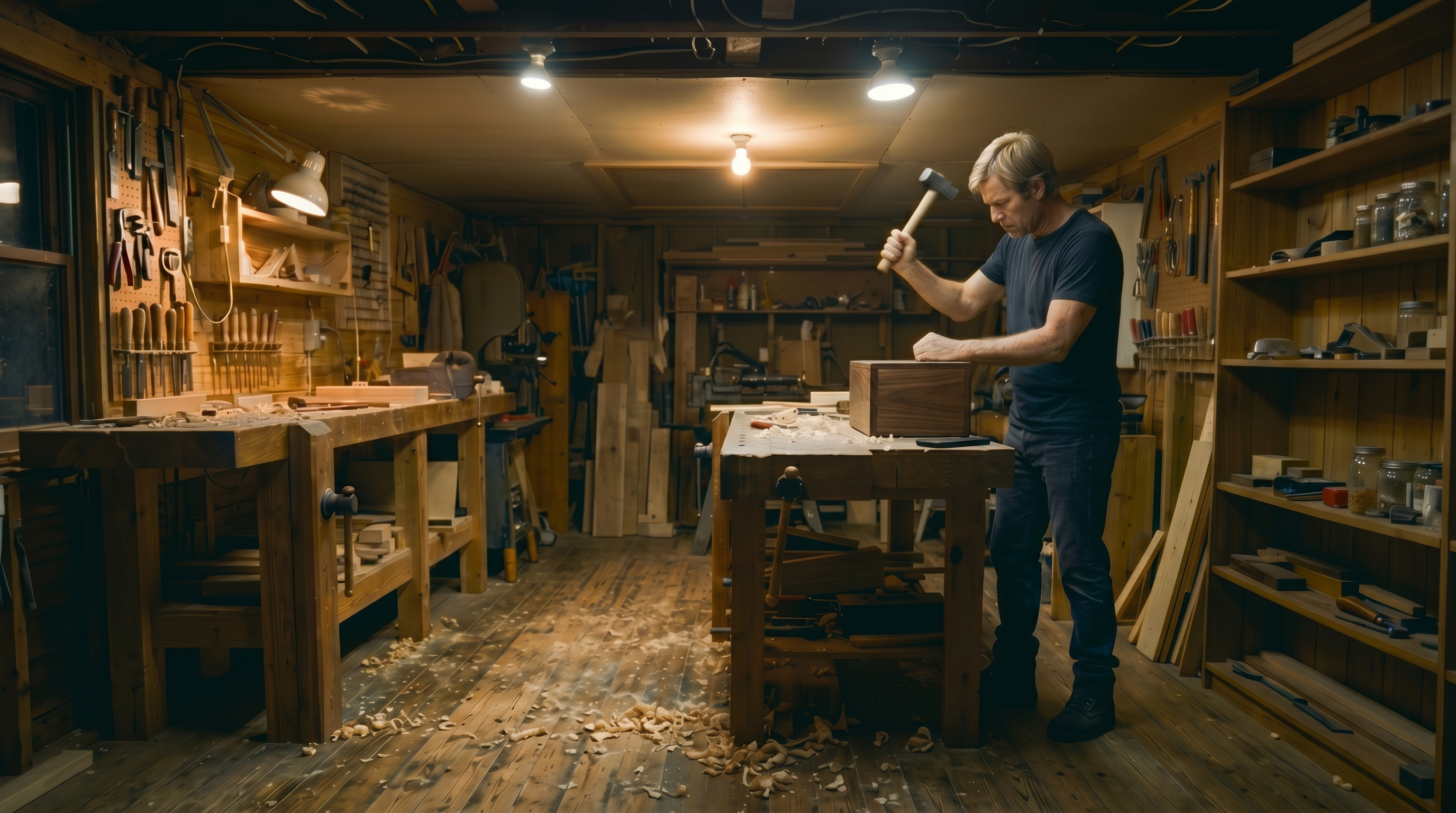
Workshop · Appearance 1
Workshop — Appearance 1
EnvINT. Workshop
Dur~5s
PhoneNot in frame · left in kitchen
Treat.Practical + slight haze · edges soft
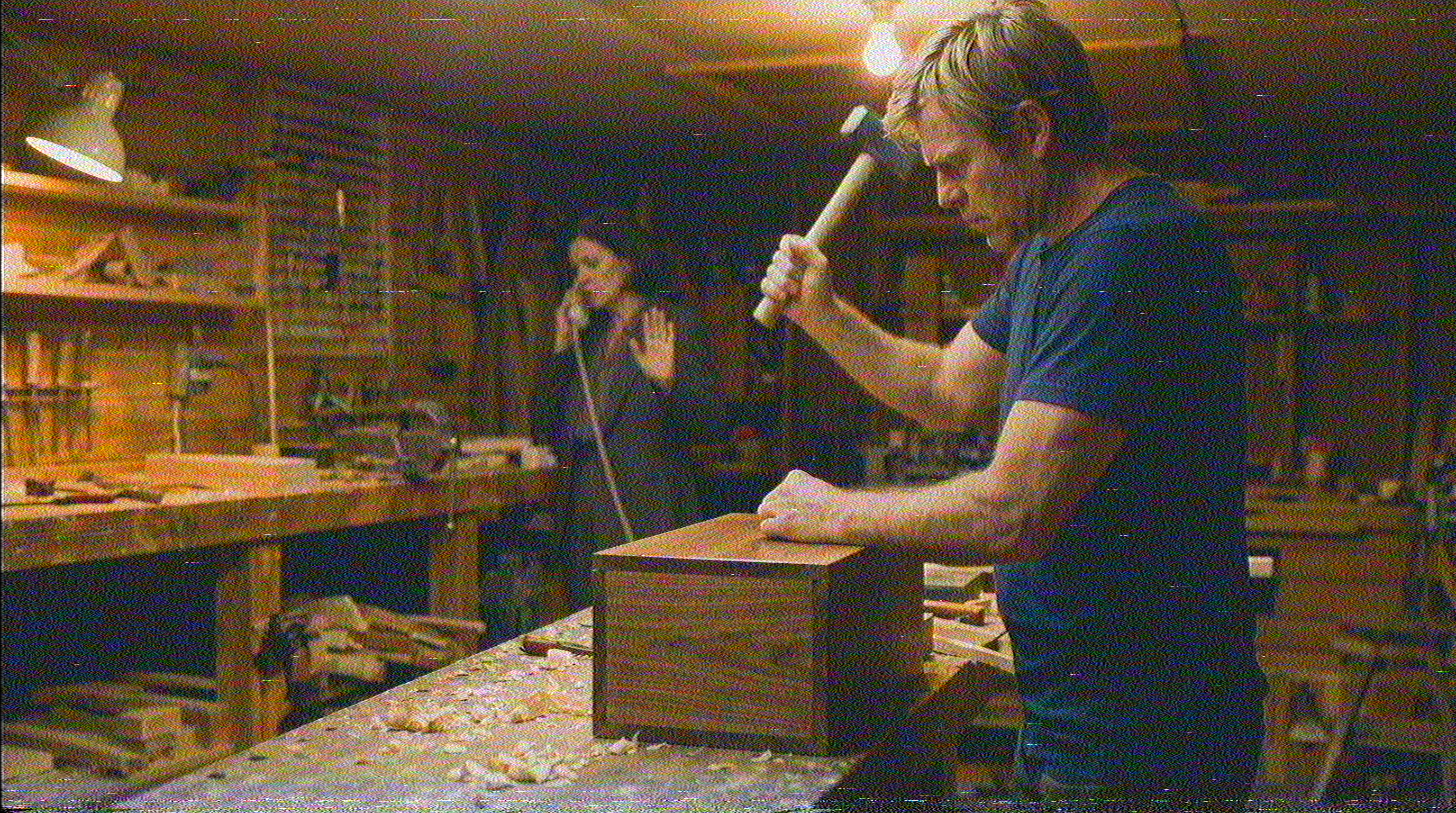
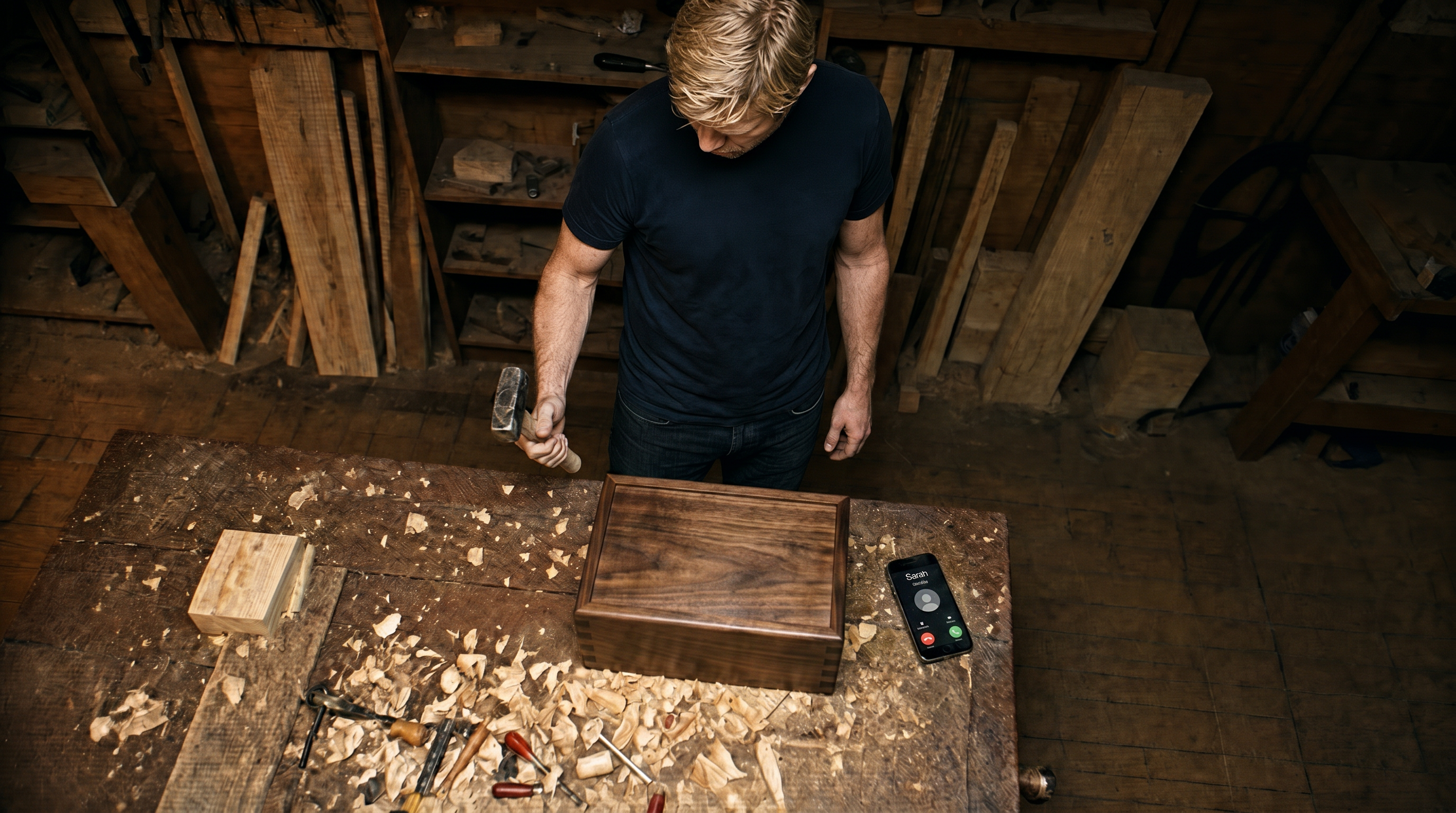
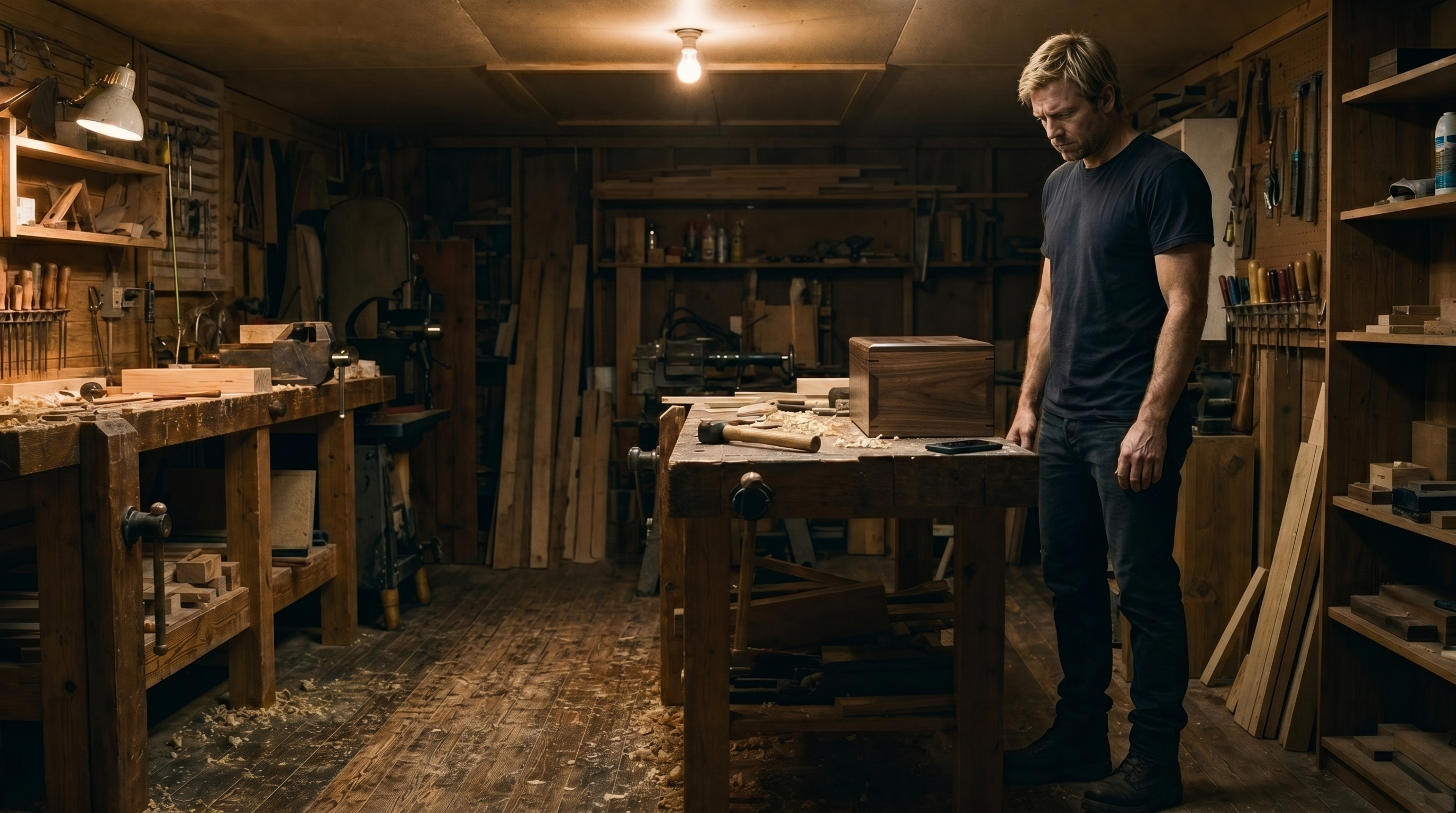
Adam hammering a small brass nail into a dark wooden box on the bench. Strikes precise. Too careful. Almost ritualized. Practical lighting, slight haze. Strikes slightly louder than real. Body: shoulders hold tension, face holds neutrality that's costing him — eyes don't look like he's enjoying this. Escape precision, not craft. He's hiding in it.
⚠ Wrong-tool staging: FULL-SIZE hammer. SMALL BRASS TACKS. Disproportion is the visual argument — do not soften it. BENCH ANGLE LOCKED — identical setup in Shots 020 and 021–025. Treatment: slight haze + soft edges, NOT full dreamlike (that is Analogy only).

"Stay clear. Stay competent. Handle it."
012
0:50 – 1:02
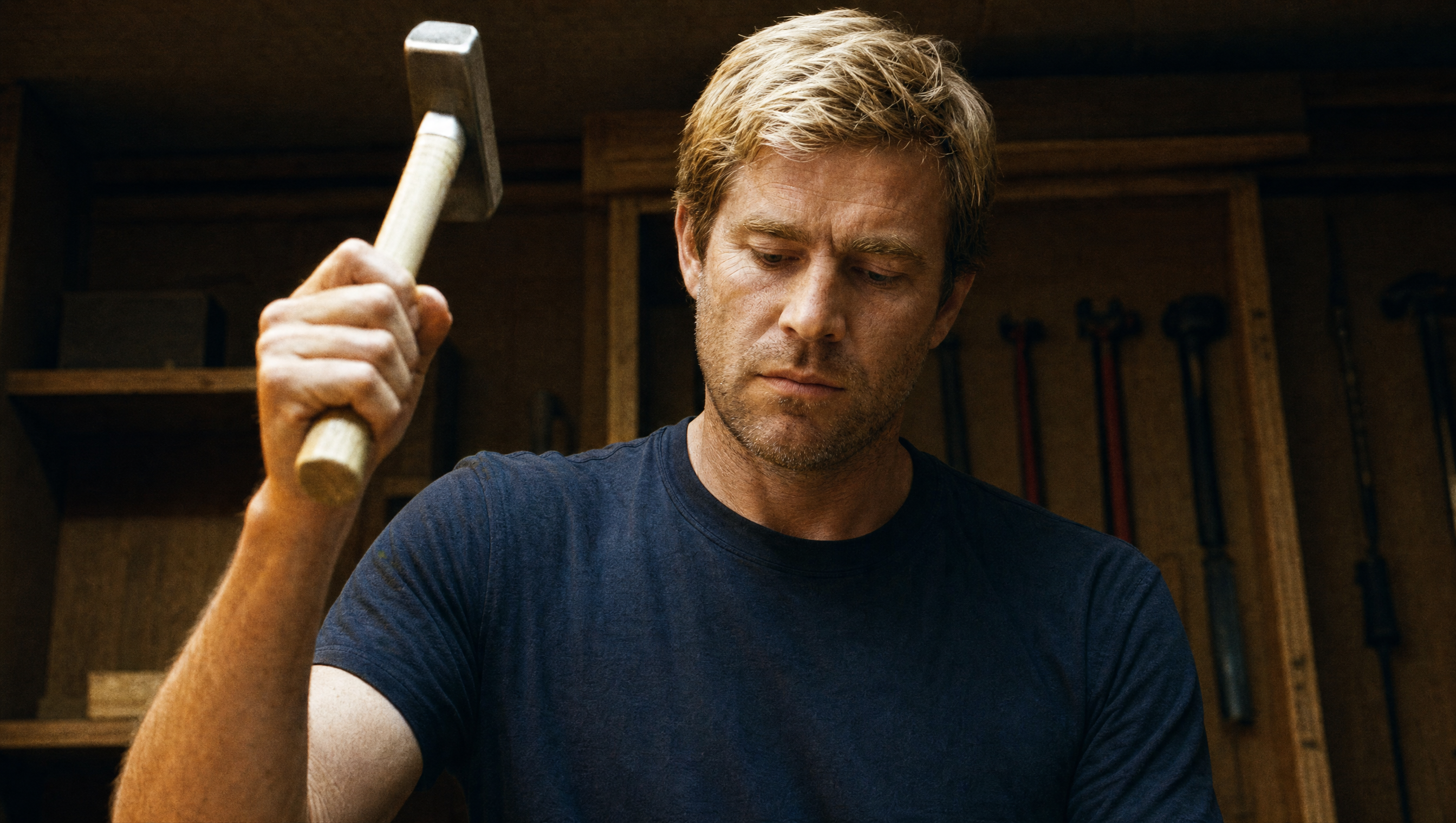
Worked Beat
Workshop — The Crack
EnvINT. Workshop
Dur~12s
PhoneNot in frame
Adam still hammering (side/three-quarter angle, first three VO lines). Around "You didn't choose thinking because it worked" — he stops mid-strike. Hammer hovers above the box. Camera moves to tighter front shot of his face. Held. "You needed it" lands on held face. The crack: small breath, slight tightening around eyes, long blink. Nothing more. He looks down. Resumes hammering — slower, even more precise.
Restraint is the register. The crack is brief and contained — composure re-locks immediately after. This is the emotional peak of the first half. No visible breakdown.

"It worked. You became the person who could be counted on. The one who didn't fall apart. You didn't choose thinking because it worked. You needed it."
013
1:02 – 1:10
Transition
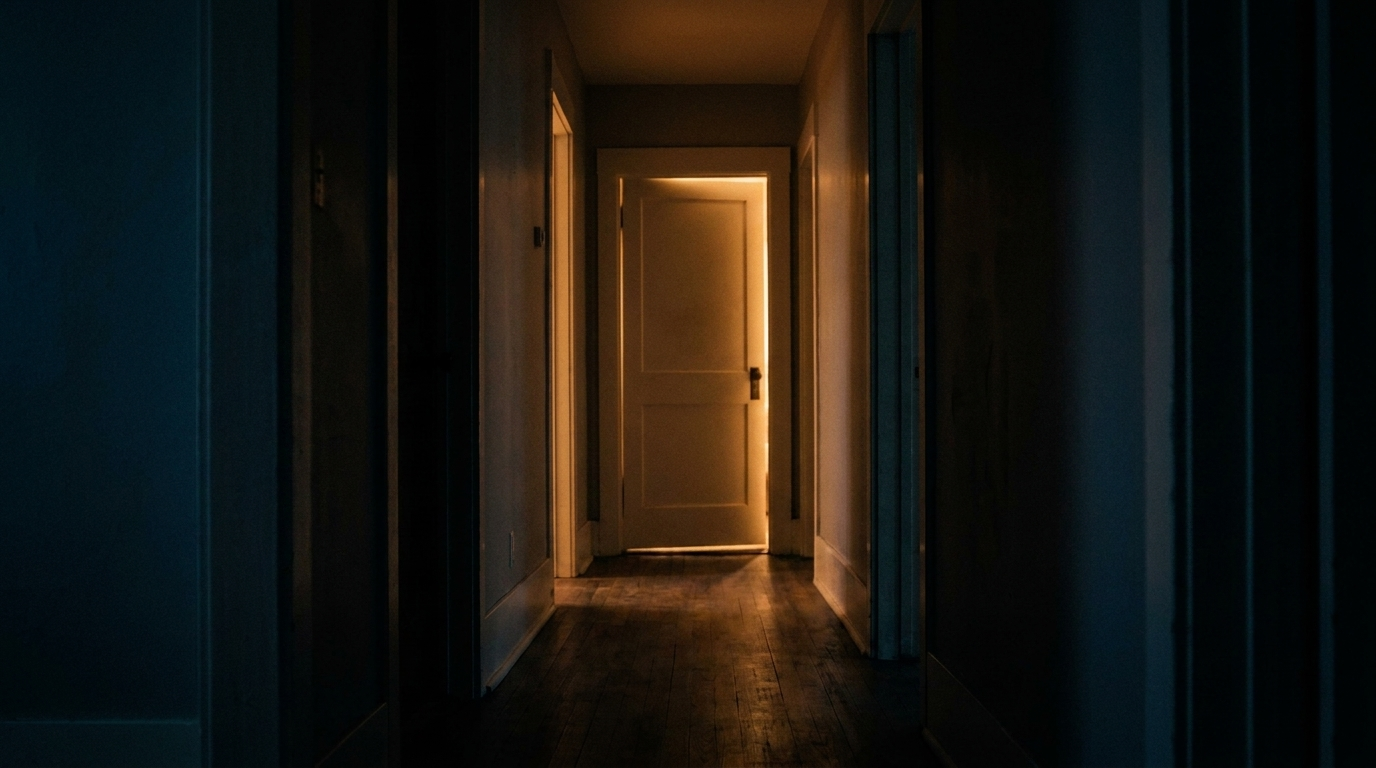
Hallway — Night
EnvWorkshop → Apartment Hallway
TimeNight
Dur~8s
Trans.Dissolve from workshop
Workshop image of Adam hammering dissolves to the apartment hallway at night. Empty. Soft light. Quiet, dim — suggestive of a space crossed many times by a man avoiding something. The hallway holds for the duration of the VO line, then dissolves into the next section.

"Analyzing doesn't close a feeling. Expression does. Action does. Letting it actually move does."
014
1:10 – 1:14
The List
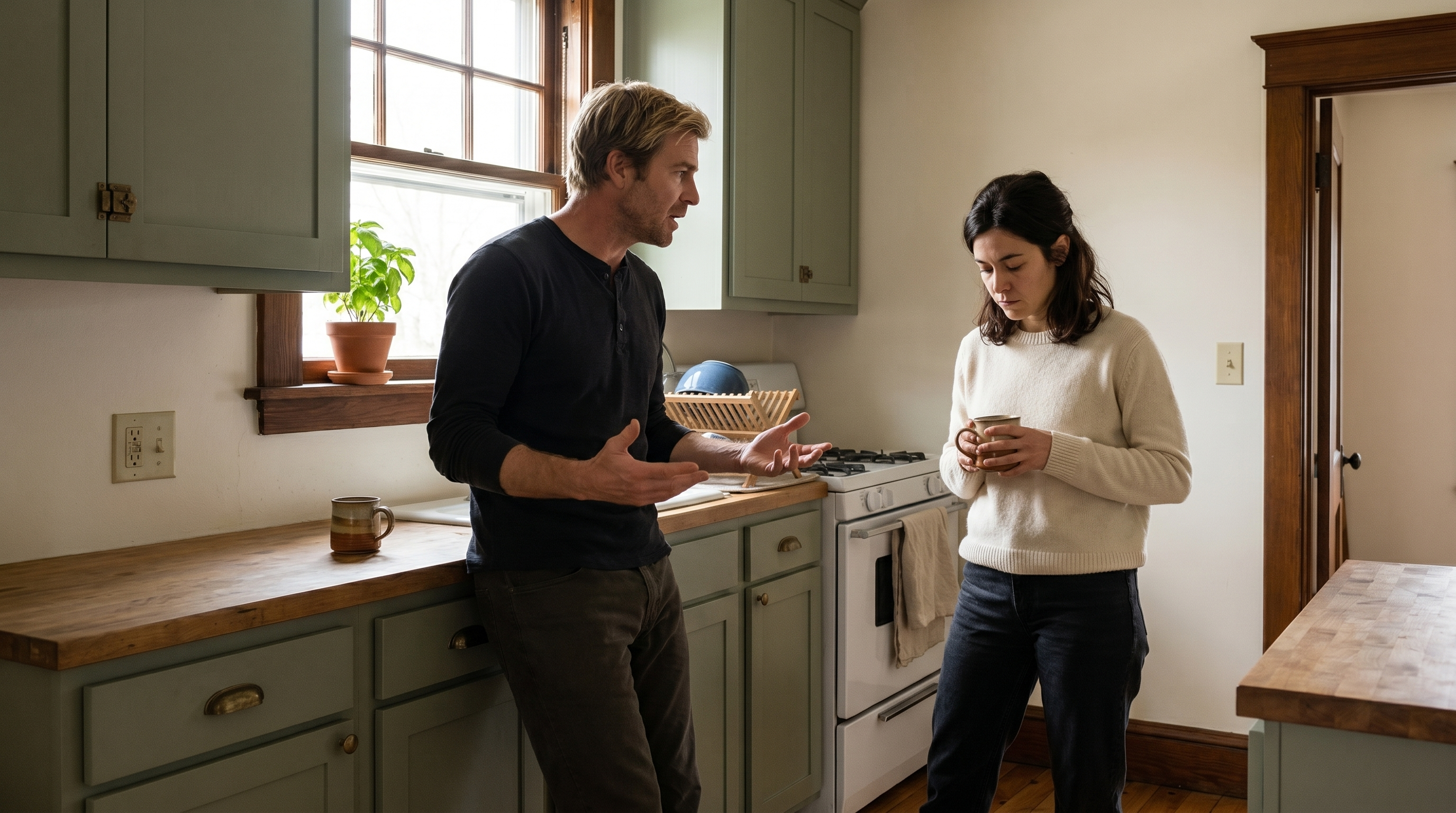
Kitchen Counter — Conversation
EnvINT. Kitchen Counter
Dur~4s
FrameWide-medium · both in frame · no close-ups
Adam camera-LEFT at the butcher-block counter, mid-sentence, hands raised in low explanation (palms open, contained). His partner camera-RIGHT, one step back from the counter — head tilted DOWN, eyes looking into a ceramic coffee mug held in both hands at chest height. NOT looking at Adam. Mouth closed, not speaking. Wide-medium framing, both in frame, negative space between them. No phone in frame. Same kitchen as S001/S005 (sage-green flat-front cabinets, butcher-block, off-white drywall, no tile, single-basin sink, herb plant on sill).
Two people in the same frame, only one connecting. Adam is connecting; partner has checked out. Reading is in the partner's downturned face + closed mouth + both hands wrapped around the mug.
Locked 2026-05-19. Earlier iterations rendered the partner mid-conversation looking AT Adam — violated the "only one connecting" direction. Final lock has her looking down into the mug, listening only halfway. Cleanup pass before video production: pull partner further back for more negative space, push modern stove out of frame (visible behind them in the storyboard render).

"Every conversation you analyzed instead of had."
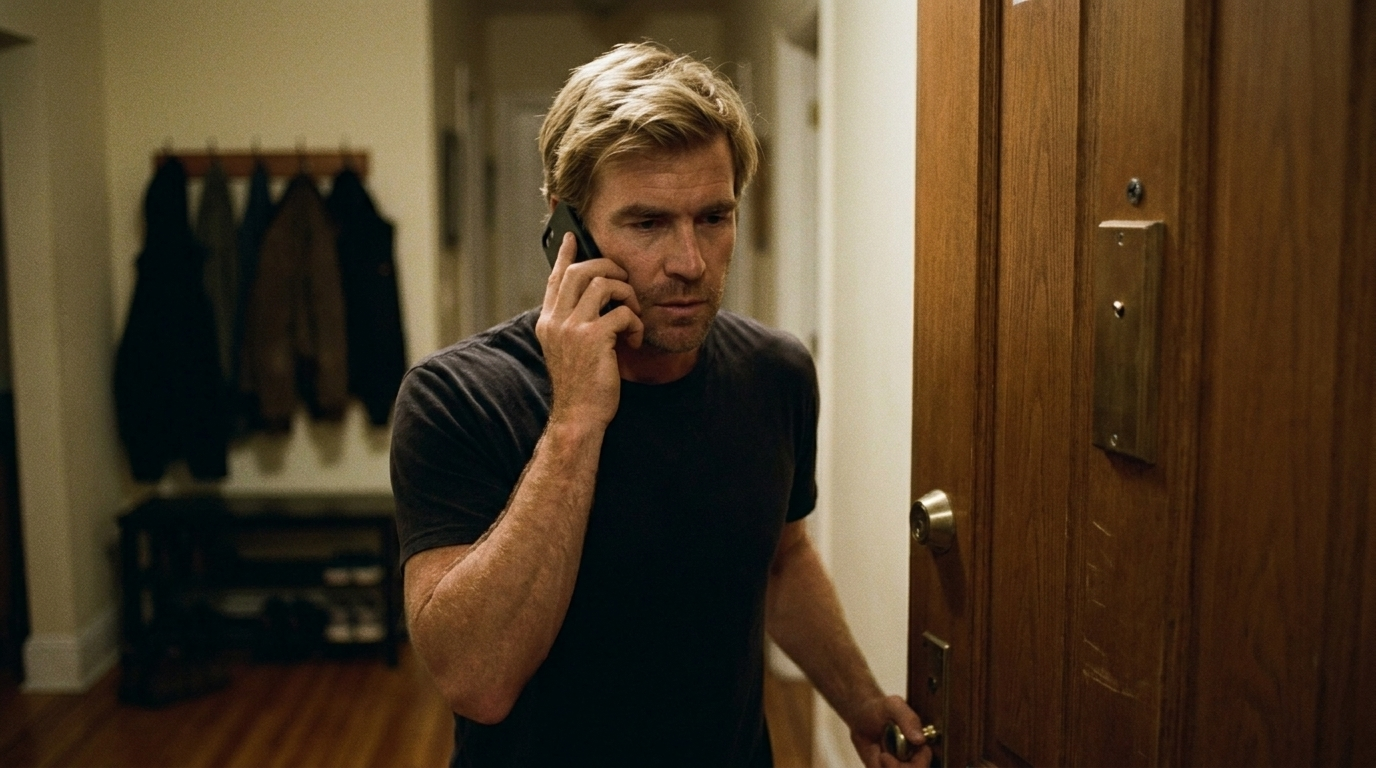
015
1:14 – 1:19
The List
Front Door — Almost-No
EnvINT. Apartment Front Door
Dur~5s
PhoneIn hand · on call
Adam at the front door, holding it open, on the phone. The other person talking (inaudible). He's about to say no — visible in the breath he takes, the slight tightening of jaw and shoulders. He doesn't. Nods instead. Small smile. Closes the door. Walks back in.
The almost-no must be physically readable in breath + tightening — not in expression. No audible speech from Adam.

"Every boundary you talked yourself out of."
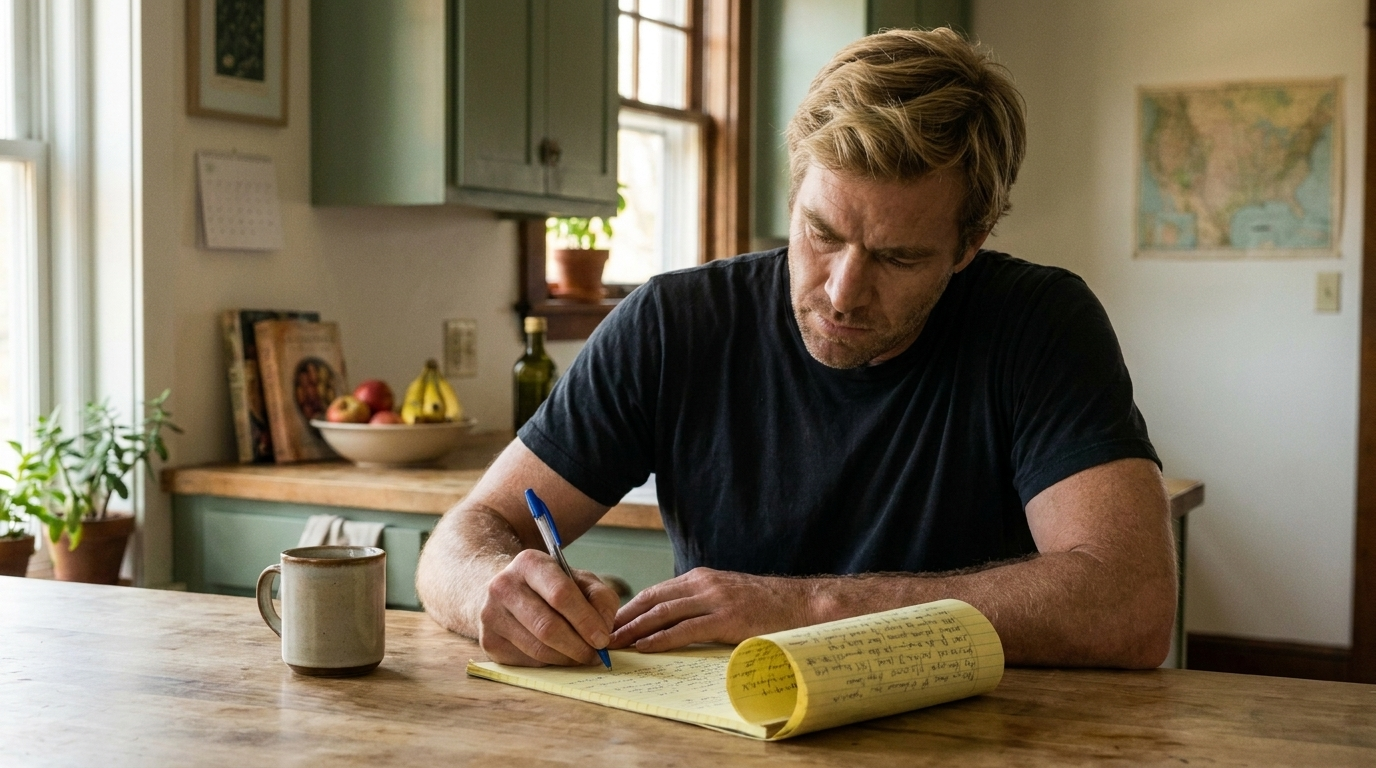
016
1:19 – 1:24
The List
Kitchen Table — Notebook
EnvINT. Kitchen Table
Dur~5s
PhoneNot in frame
Adam at the kitchen table, writing in a notebook by hand. Methodical. Articulate to himself. The notebook is full — previous pages dense with handwriting visible as he flips to a fresh one. No phone in frame.

"Every feeling you turned into a paragraph instead of letting it move."
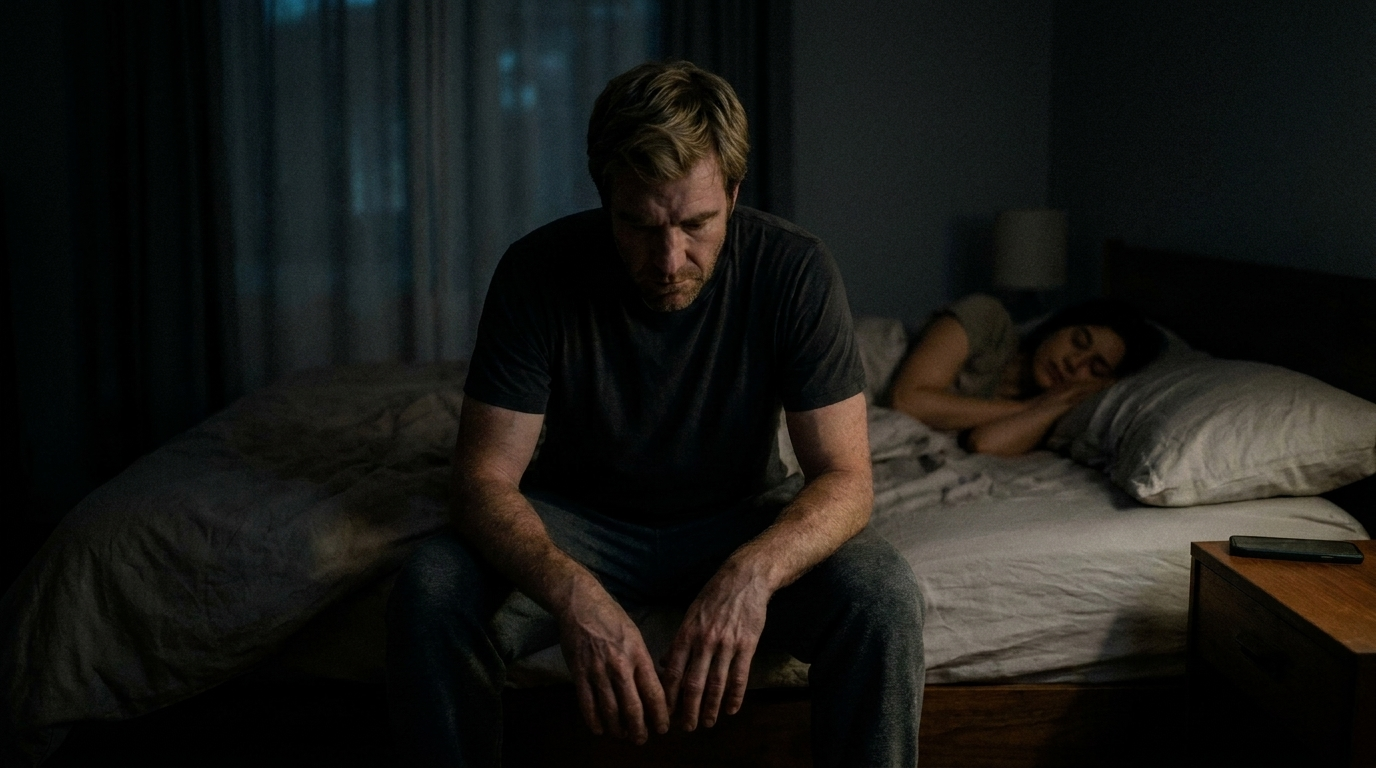
017
1:24 – 1:30 · SILENT
Silent Sequence · Tentpole
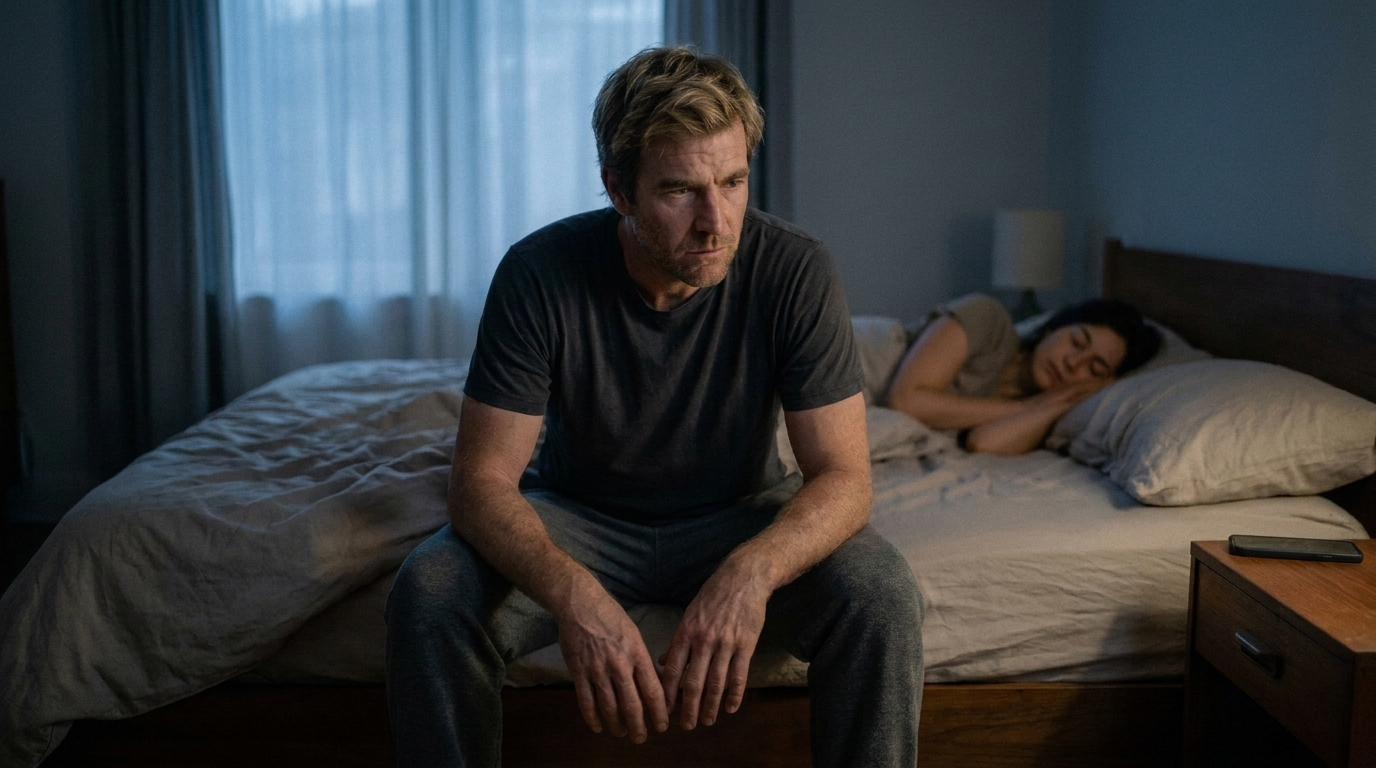
Bedroom — Silent Sequence
EnvINT. Bedroom
TimeNight · dark room
Dur~6s · NO VO
PhoneFace-down on nightstand
ScoreNo piano · pad only
Adam sitting on the edge of the bed. Partner asleep behind him, turned toward the empty space he's left. Phone face-down on the nightstand. Adam looking at the floor. Not lying down. Not getting up. Two people in the same room — only one of them present. Body: (1) shoulders slightly hunched, (2) long held breath — upper-chest, chest does not fully drop, (3) fingers slightly curled on thighs gripping nothing, (4) long blink, eyes opening to nothing in particular.
⚠ ALL FOUR body cues lock: shoulders hunched / held breath / fingers curled / long blink. The held breath is load-bearing — the body holding what the VO is about to name. Do not drop it.
[No VO — 5 to 6 seconds.]
018
1:30 – 1:54
Tradeoff Flip
Bedroom — The Cost
EnvINT. Bedroom · continuous from 017
Dur~15s
PhoneFace-down on nightstand (continuous)
Adam still on the edge of the bed. Same position as Shot 017, continuous. He doesn't move position or change posture. Body: long slow exhale visible in his chest (upper-chest, controlled), jaw slightly set, shoulders slightly hunched, fingers curled on thighs gripping nothing, eyes unfocused looking at floor without seeing it.
The stillness IS the impact. He has been hit and is showing no visible sign. Suppression cost is in the body, not the face. Breath still upper-chest here — diaphragm release is reserved for Shot 026.

"None of them closed. They're still open. Quietly using up capacity. That's why a small thing knocks you sideways. You're not reacting to one thing. You're responding to everything that never closed."
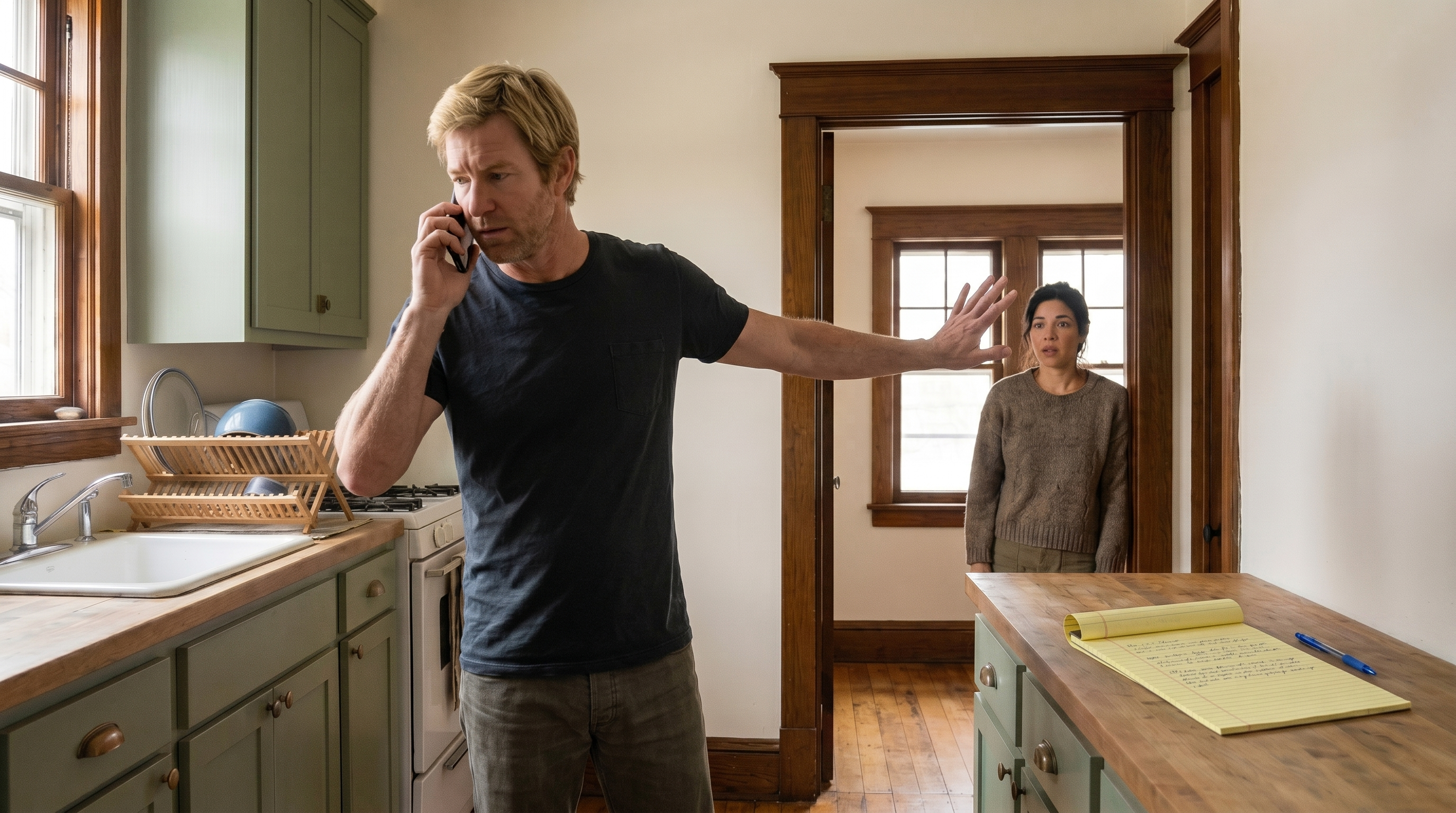
019
1:54 – 2:02
The Corner
Kitchen — Presence Trigger
EnvINT. Kitchen
Dur~8s
Adam camera-left at the kitchen counter on a phone call, head turned toward the call. Partner enters the doorway camera-right-back. Before she can speak, Adam's free hand lifts toward her — palm out, fingers spread, at chest height. The same "not now" gesture from Memory Shot 1 and Analogy Beat 3. He walks past her without looking. A yellow legal pad with handwritten pages sits on the island camera-right — he was processing on paper before the call came in.
The hand lift is subtle. He's not rude — he's already gone internally before she speaks. No audible speech from either character.
Staging shift from script — opportunity flagged. Script direction reads "Adam at the kitchen counter. Doing something small. Wiping it. Tidying." Through the build I saw an opportunity to strengthen the beat: stage Adam on a phone call with his free hand raised palm-out toward the partner as she enters — the exact same "not now" gesture used by Mom in Memory Shot 1 and the figure in Analogy Beat 3. He is now doing to his partner what was done to him as a child. The pattern made visible without naming itself. The legal pad on the island also ties back to S016 — he was writing on paper before the phone rang. Two analytical strategies running in parallel (phone + paper); her presence interrupts neither.

"You can't think a feeling closed. The part of you that's good at thinking is the part that's most loyal to staying safe."
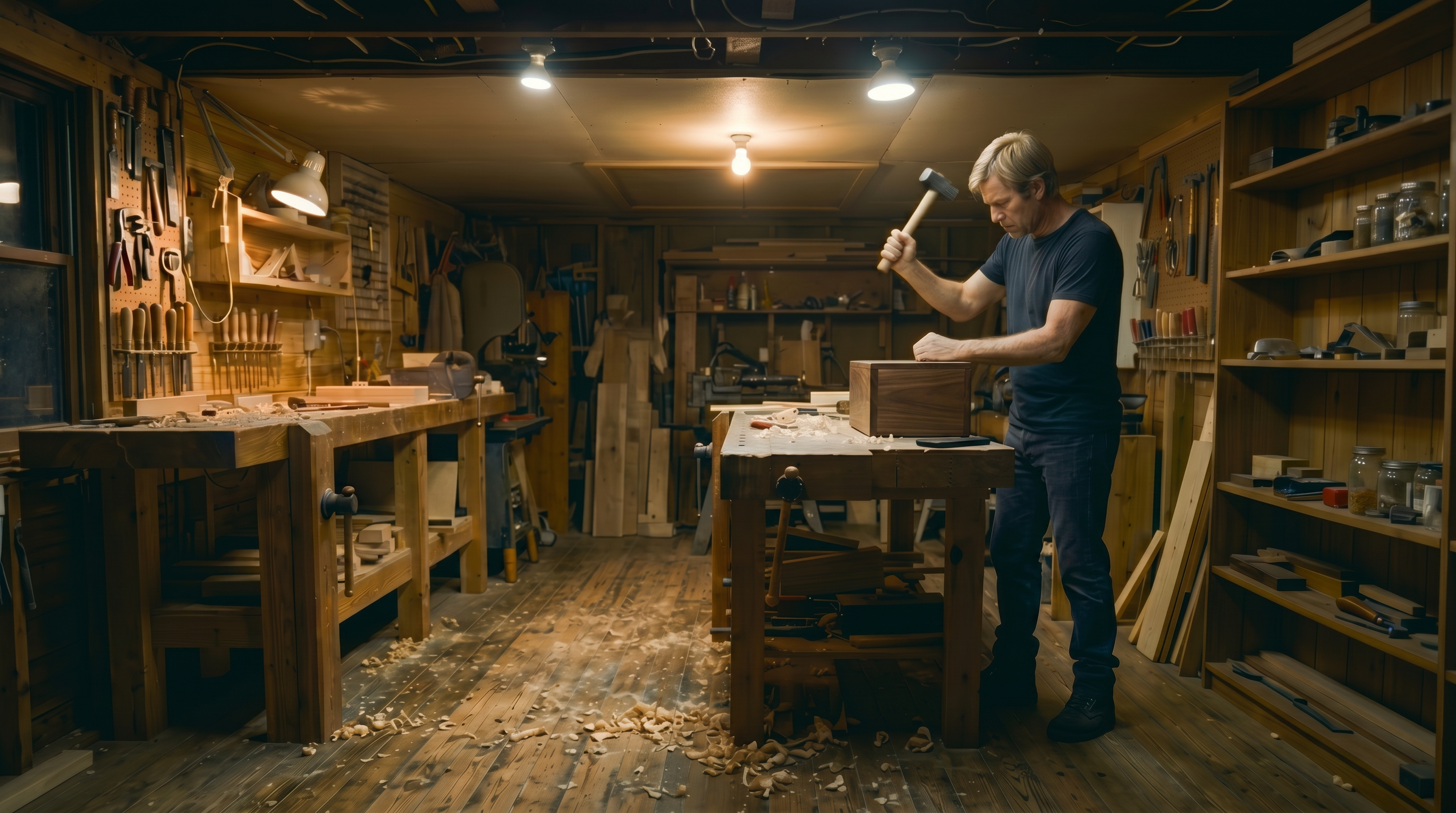
020
2:02 – 2:11
Workshop · Appearance 2
Workshop — Appearance 2
EnvINT. Workshop · identical to Shot 011
Dur~5s
PhoneNot in frame · left face-down in kitchen
Visually identical to Shot 011. Same bench angle. Same wooden box. Same hammer. Another small brass nail. Same precision, same posture, same pace. Practical lighting, same slight haze, same strike volume. Adam has not changed. The workshop has not changed. The only new fact: we have been here before.
⚠ The argument of this appearance IS the repetition. Do not alter posture, pace, precision, lighting, or bench angle from Shot 011. He's reaching for the tool before there's even real provocation.

"The part that's most loyal to staying safe."
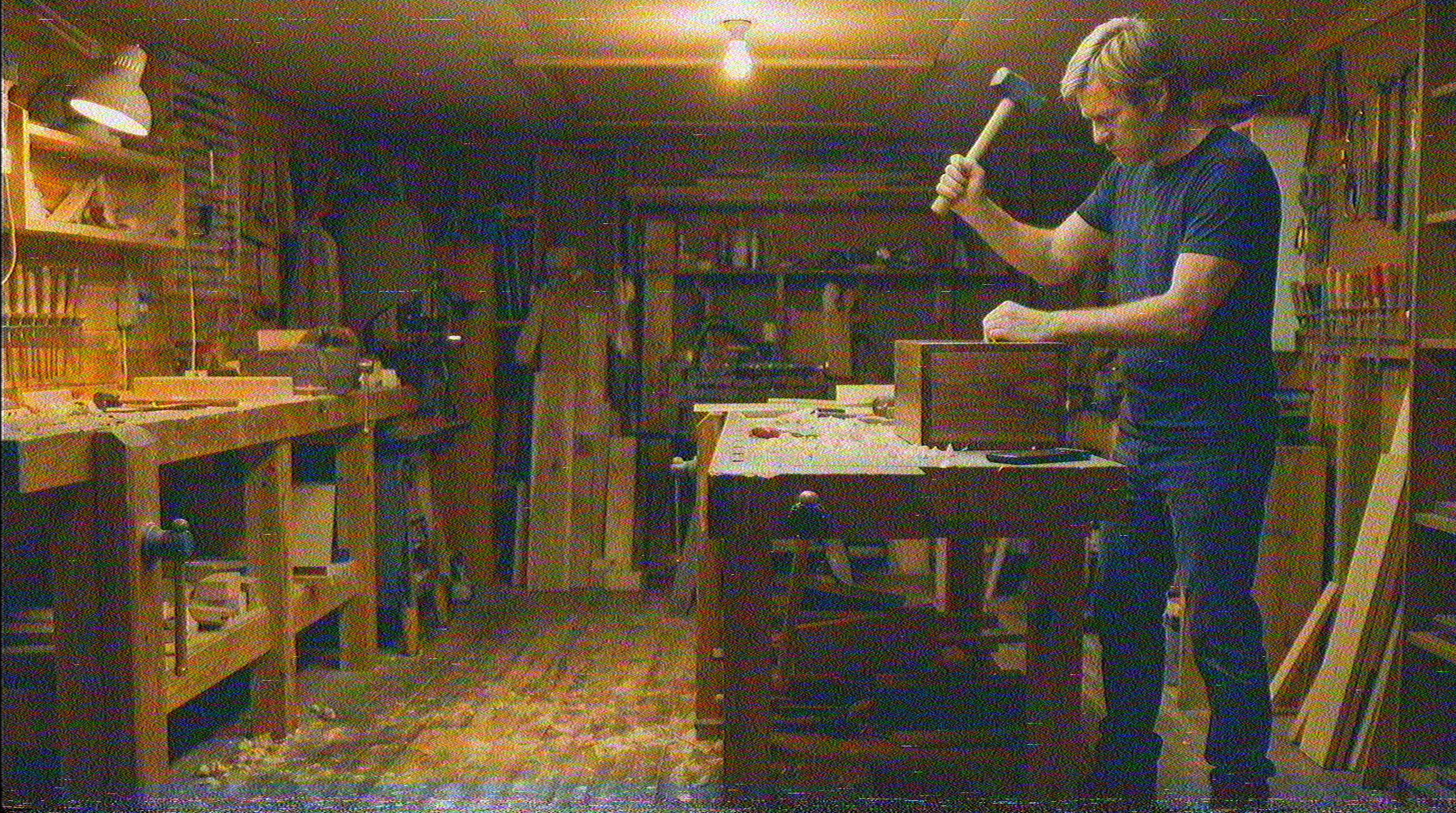
021
2:11 – 2:14
Analogy · Beat 1
Analogy — Entering Dreamlike
EnvINT. Workshop (entering dreamlike)
Dur~3s
Treat.VHS treatment applied (memory mode)
Tight on Adam at the bench. Brass nail. Wooden box. Slow, precise strike. As we watch: lighting shifts subtly — softer, hazier. Sound of the strike stretches slightly. Focus on the edges of frame goes dreamy. The viewer reads: we're entering a different mode. Beat 1 is the visual shift INTO dreamlike — lighting softens, edge focus goes hazy, sound stretches.
Jump from Appearance 2 to Analogy is a SINGLE CUT — sharp, no gradient. Adam stays identical throughout all analogy beats. The workshop changes around him; Adam does not.
Choreography note — S020→S024 plays as one continuous dolly-in. S020 (clean present, wider) → dolly begins → S021 dolly midpoint, VHS treatment kicks in → S022 boy with drawing appears → S023 boy disappears, mom appears in shadowed back corner → hard abrupt cut to S024 (phone ringing, present returns). The dolly is the spine of the analogy. The apparitions (boy, then mom) shift over the camera move. VHS is the visual code; the dolly is the mechanism.

"You've been using the only tool you know on the things it can't reach."
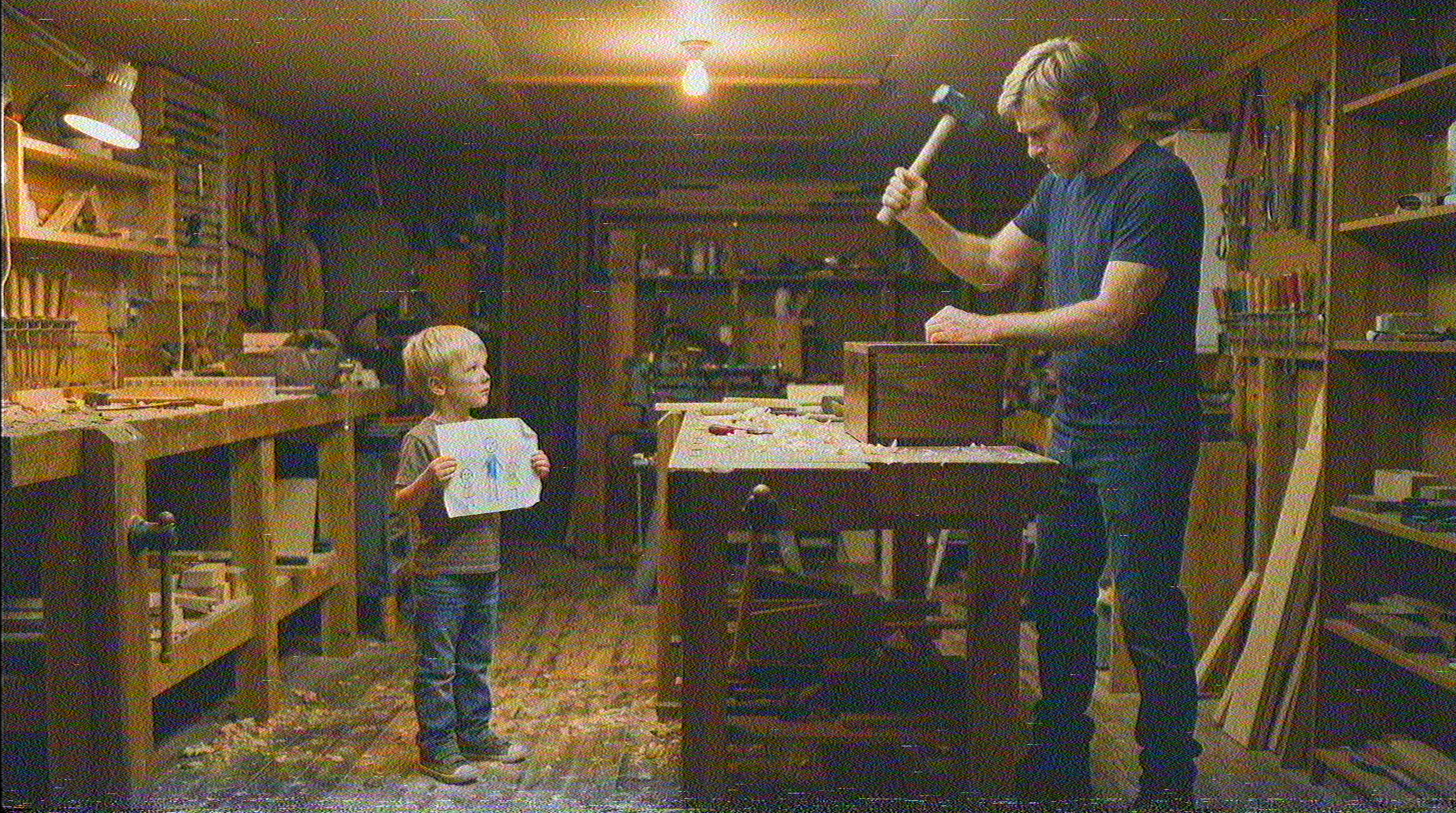
022
2:14 – 2:18
Analogy · Beat 2
Analogy — The Child
EnvINT. Workshop (memory mode)
Dur~4s
Treat.VHS treatment applied (memory mode)
Wide reveal: the same boy from Memory Shot 1 (~5–6) standing in the workshop, a few feet from Adam. Looking up at Adam. He is holding the same drawing from Shot 007 — same three stick figures, blue/yellow crayon, SAME BENT CORNER top right. Offering it to Adam. Adam keeps hammering. Doesn't turn. Full dreamlike-hazy treatment.
⚠ Critical: drawing must visually match Shot 007 — three stick figures, blue/yellow crayon, bent corner top right. The bent corner is the identifier. Same child visual reference as memory shots.
[VO continues over analogy section]
023
2:18 – 2:22
Analogy · Beat 3
Analogy — Mother Silhouette
EnvINT. Workshop (memory mode)
Dur~4s
Treat.VHS treatment applied · canonical mother portrait
Workshop back corner, mid-depth, shadowed. The mother — same canonical portrait as Shot 007 — stands in the dark holding a rotary handset to her ear, "not now" hand raised at chest height, palm out, fingers together. Face oriented toward the call (toward the light), not toward Adam. Adam at the bench, side-profile, mid-strike. Doesn't turn. Total silence on the figure.
⚠ Critical: mother identity must match Shot 007 — same face, same business-casual register, same hand gesture. The visual rhyme between Memory Shot 1 and this beat IS the reveal.
Deviation from script — defended. Script direction for this beat: "A silhouette of an older figure, lit from behind by the apartment. Held. Still in the doorway, still raising the hand." Our staging moves her from the workshop doorway (script) to the workshop's shadowed back corner (here), and renders her with recognizable identity — the canonical mother portrait, same face as Memory Shot 1 — holding a rotary handset to her ear. Three reasons we chose this over the silhouette-in-doorway approach:

(1) Recognizable identity beats silhouette for the visual rhyme. The whole point of this beat is the viewer connecting "this is the same person who dismissed him in Memory Shot 1." Silhouette ambiguity dilutes the connection. A face clearly the same person makes the rhyme snap into place.

(2) The rotary handset extends the dismissive act behaviorally. In Memory 1 she's on a phone call, hand up, "not now." Putting her on the same call IN HIS WORKSHOP — same era-appropriate handset — reads as the same act of dismissal continuing in time. A behavioral callback (still on the call, still raising the hand) lands stronger than a geographic one (still in the doorway).

(3) Back-corner-in-shadow reads "embedded the whole time," not "arriving at the threshold." The analogy is the unconsciousness made visible. She hasn't arrived at the dream-workshop's door — she's been present underneath his hammering all along, in the shadowed corner he wasn't looking at. The shadow placement is the unconscious's natural register.

What we give up: the literal apartment-light bleed through the doorway. The VHS memory-mode treatment carries the world-bleed without needing the literal light source — the treatment IS the bleed.
[VO continues over analogy section]
024
2:22 – 2:25
Analogy · Beat 4
Analogy — Phone on Bench
EnvINT. Workshop workbench (dreamlike)
Dur~3s
PhoneFirst time in workshop · lit · vibrating silently
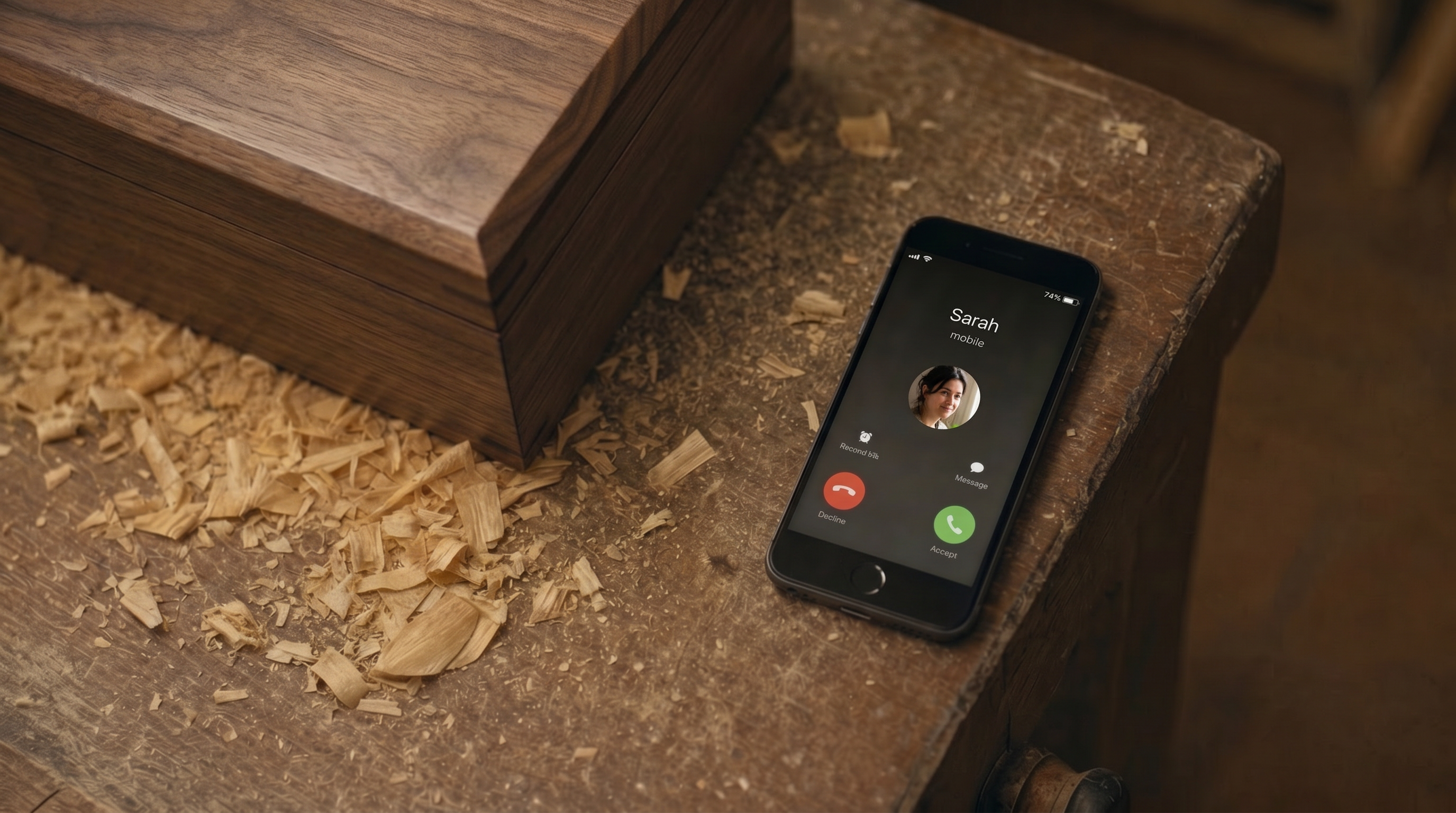
Phone on the workbench beside the wooden box. Lit — partner's name on the incoming-call screen. Vibrating silently — phone shifts slightly from vibration. Sound of vibration audible, soft, persistent — the only sound besides the pad. Hard cut from S023 (memory mode) into this beat (clean present). The cut breaks the analogy world; the modern phone is what pulls Adam back to the present.
⚠ Structurally important: first time the phone enters the workshop. The cut from S023 to S024 is HARD and ABRUPT — the analogy ends here. Vibration sound carries into Shot 025 across the next visual cut.
[VO continues over analogy section]
025
2:25 – 2:28
Analogy · Beat 5
Analogy — Hand on Hammer
EnvINT. Workshop (dreamlike)
Dur~3s
AudioPhone vibration from Beat 4 carries across cut
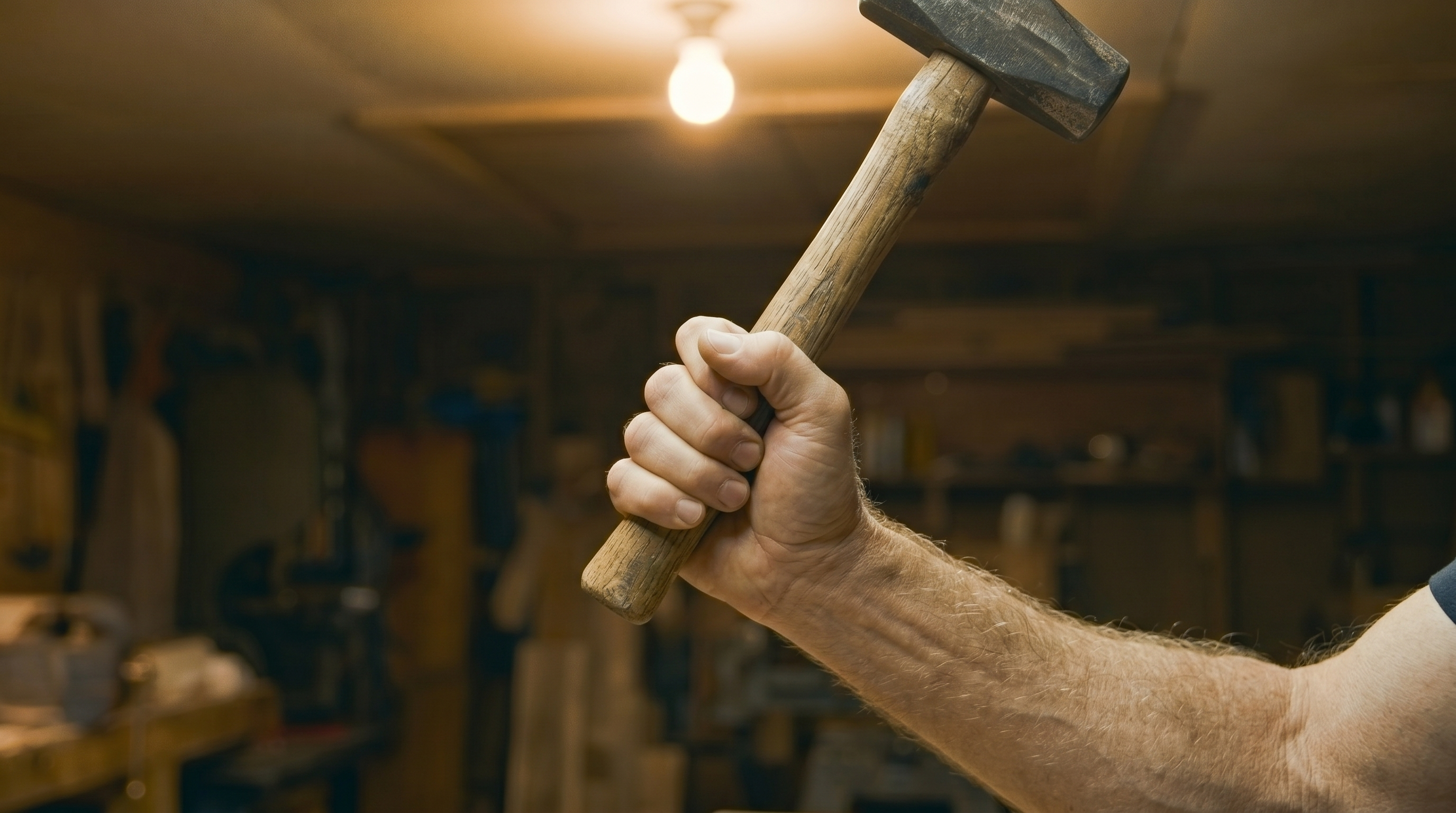
Tight on Adam's hand around the hammer. Grip tight. Knuckles slightly visible. A strike comes down on a brass nail. Then another. Off-frame, the phone is still vibrating — the vibration sound carries across this cut. He keeps hammering. The cut from the phone (Beat 4) to this hand (Beat 5) IS the choice: he sees, in some peripheral way, and chooses the hammer.
Phone vibration sound from Shot 024 continues into this shot — carries across the visual cut. The viewer hears the phone he isn't picking up while watching the strike come down. The cut is the choice.
[VO continues over analogy section]
026
2:30 – 2:38 · SILENT
Uncomfortable Hold · Tentpole
Workshop — Sets It Down
EnvINT. Workshop
Dur~8s · NO VO
ScorePiano returns briefly, then drops
Cut to tight front frame on Adam. Hammer at his side, grip slack. He looks at the hammer — not the box, not the bench, not at us. He examines it the way you look at something you've never really looked at. Over ~3 seconds: hand opens, sets the hammer down BESIDE the wooden box (deliberately — not gently, not violently), half-step back from the bench, hands down at sides, hand that was holding stays curled then relaxes. He exhales — THE FIRST DIAPHRAGM BREATH OF THE VIDEO. Chest drops. Shoulders drop. Breath releases downward. Head tilts slightly down.
⚠ Hammer placed BESIDE the box — not pushed away. Both tool and project on the bench. He steps back from BOTH. The exhale here is fundamentally different from every prior breath: diaphragm release, not upper-chest. This is the video's climax. Reading: not anger, not gentleness — "I need a break from this."
[No VO — ~3 seconds.]
027
2:38 – 2:48
Final Line
Workshop — Final Line
EnvINT. Workshop
Dur~10s
ScoreMusic drops out · total silence
CutHard cut to black on "underneath"
Adam standing back from the bench. On the bench: hammer set down beside the wooden box. Phone still vibrating silently. Adam's hands at his sides, empty. He's looking down or away. Music has dropped out — total silence. Hard cut to black on the final word "underneath." No fade.
Everything remains on the bench: hammer, box, phone. He hasn't left the workshop. He's only stepped back. Hard cut — no fade, no dissolve.

"Your logical mind kept you safe. It can't catch what's accumulated underneath."
028
2:48 – 3:00
End Card
End Card
Dur~12s · hold black 2-3s then fade in
Hold black 2–3 seconds after hard cut. End card fades in. Hold 4–5 seconds.
"no shortcut. real therapy." · MMHC logo, light font weight. Standard series end card.
[No VO]